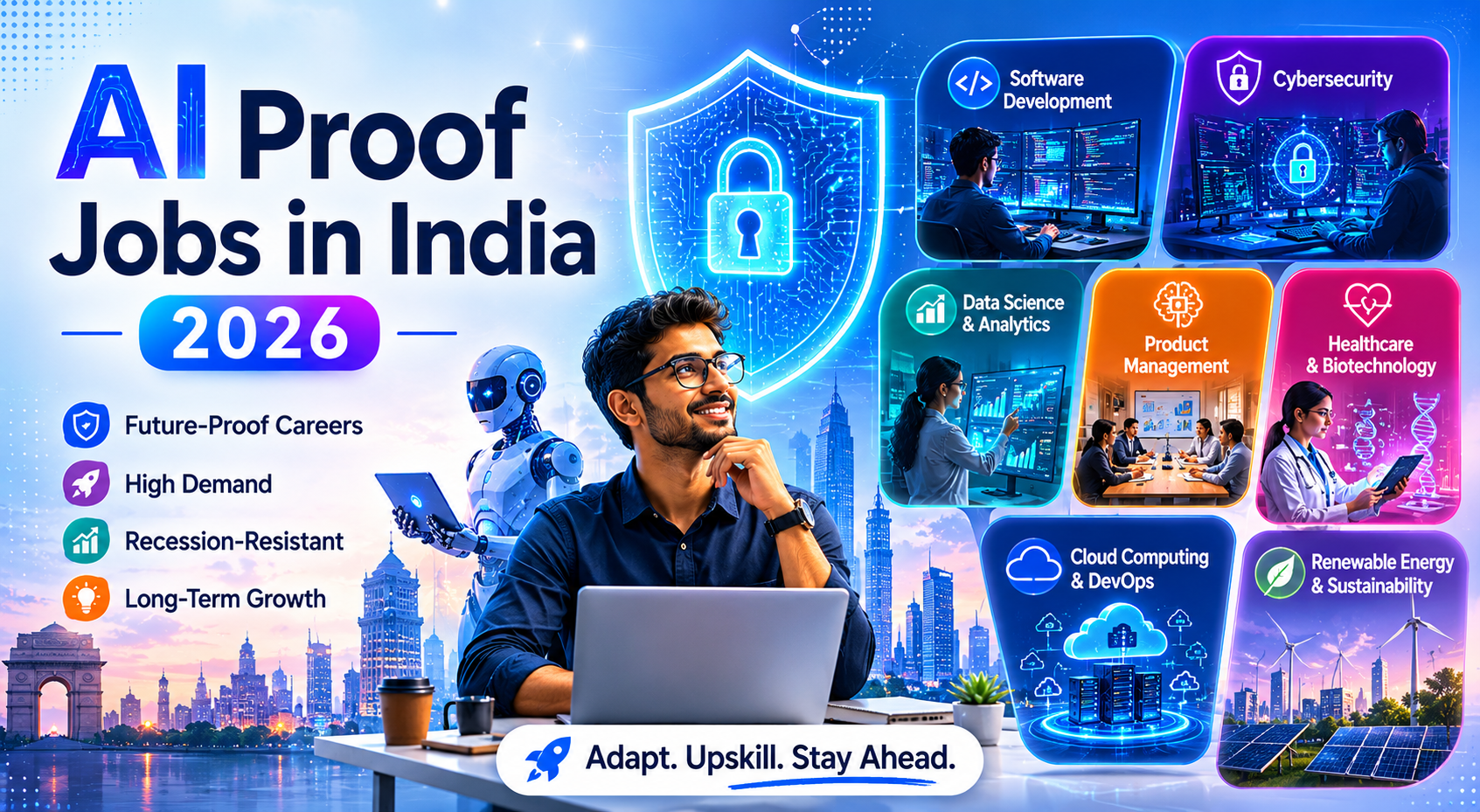
Imagine you are a 26-year-old software developer in Pune, and your entire entry-level testing pipeline has just been handed to an AI agent. Or you are a writer in Chennai, and a model now drafts in minutes what used to take days. This is not a distant warning. It is ordinary work life in India, 2026.
And yet, in the same moment, a therapist in Mumbai has no empty slots, a nurse in Bengaluru is more indispensable than ever, and an electrician in Delhi has a waiting list. AI and Indian jobs are not one story. They are two stories running in parallel.
The question most people ask wrong
Most conversations start with: "Will AI take my job?" The more useful question is: which parts of my work require something a machine cannot provide? That answer defines your long-term security.
Across IMF, World Bank, WEF, and industry reports, the pattern is consistent: repetitive white-collar tasks face real pressure, but net job creation remains plausible as new categories emerge. This is a skills reshuffle, not a total collapse.
AI will not replace humans. Humans who use AI will replace humans who don't.
Why some jobs remain structurally machine-resistant
AI is exceptional at pattern recognition, scale, and prediction. Careers become resilient when their core value lies outside those strengths:
- Physical presence: real-world tasks in unpredictable environments.
- Emotional trust: care, counseling, teaching, and conflict mediation.
- Licensed accountability: legal, clinical, and fiduciary responsibility.
- Strategic originality: vision, leadership, and contextual judgment.
Seven categories of AI-proof work in India
Healthcare
High demand · High trust
Strong resilienceAI can assist diagnosis and workflow, but bedside trust, physical examination, and clinical accountability remain deeply human.
Mental Health
Undersupplied nationwide
Critical shortageTherapeutic outcomes depend on relational depth, empathy, and continuity. In therapy, the human relationship is the product.
Skilled Trades
Blue-collar renaissance
Rising premiumsElectricians, plumbers, mechanics, and on-site technicians solve physical, variable problems that cannot be fully virtualized.
Education
Mentorship-driven
Augmented, not replacedAI tutors can assist practice, but teachers still drive motivation, developmental judgment, and social learning in real classrooms.
Legal & Compliance
High accountability
Judgment moatDrafting may accelerate with AI, but advocacy, risk interpretation, and liability-bearing decisions stay human by design.
AI & Cybersecurity
Fastest growth cluster
Compounding demandThe humans who build, test, govern, and defend AI systems become more central as adoption scales.
Creative Direction
Meaning over output
Human advantageGenerative models can imitate style; they cannot own context, identity, and lived cultural meaning.
Leadership & Management
Cross-functional premium
Hard-to-automateVision setting, accountability, conflict navigation, and team trust remain core leadership functions machines cannot absorb.
In several metros, expert skilled-trade workers now out-earn many mid-level desk professionals on an hourly basis. Economics is quietly rewriting status assumptions about "safe" careers.
No job is fully immune
"AI-proof" does not mean "AI-untouched." Surgeons now use AI-assisted imaging. Teachers use adaptive systems. Lawyers use AI research tools. The key distinction is whether AI replaces your core value or amplifies it.
Professionals who combine domain depth with AI fluency increasingly command salary premiums, especially when they own outcomes, quality, and accountability instead of only task execution.
What this means for your career in India
India's position is paradoxical: automation pressure is real in process-heavy sectors, yet the country continues to grow its talent pool, project-based hiring, and AI-adjacent opportunities.
Practical strategy for the next 24 months:
- Build one AI workflow in your current role and document outcomes.
- Move from task ownership to quality and decision ownership.
- Develop one trust-heavy capability: mentoring, client advisory, or high-stakes communication.
- Choose sectors where demand outpaces supply, not just where headlines are loudest.
The strongest careers in the AI era are not anti-technology. They are deeply human and technologically fluent at the same time.