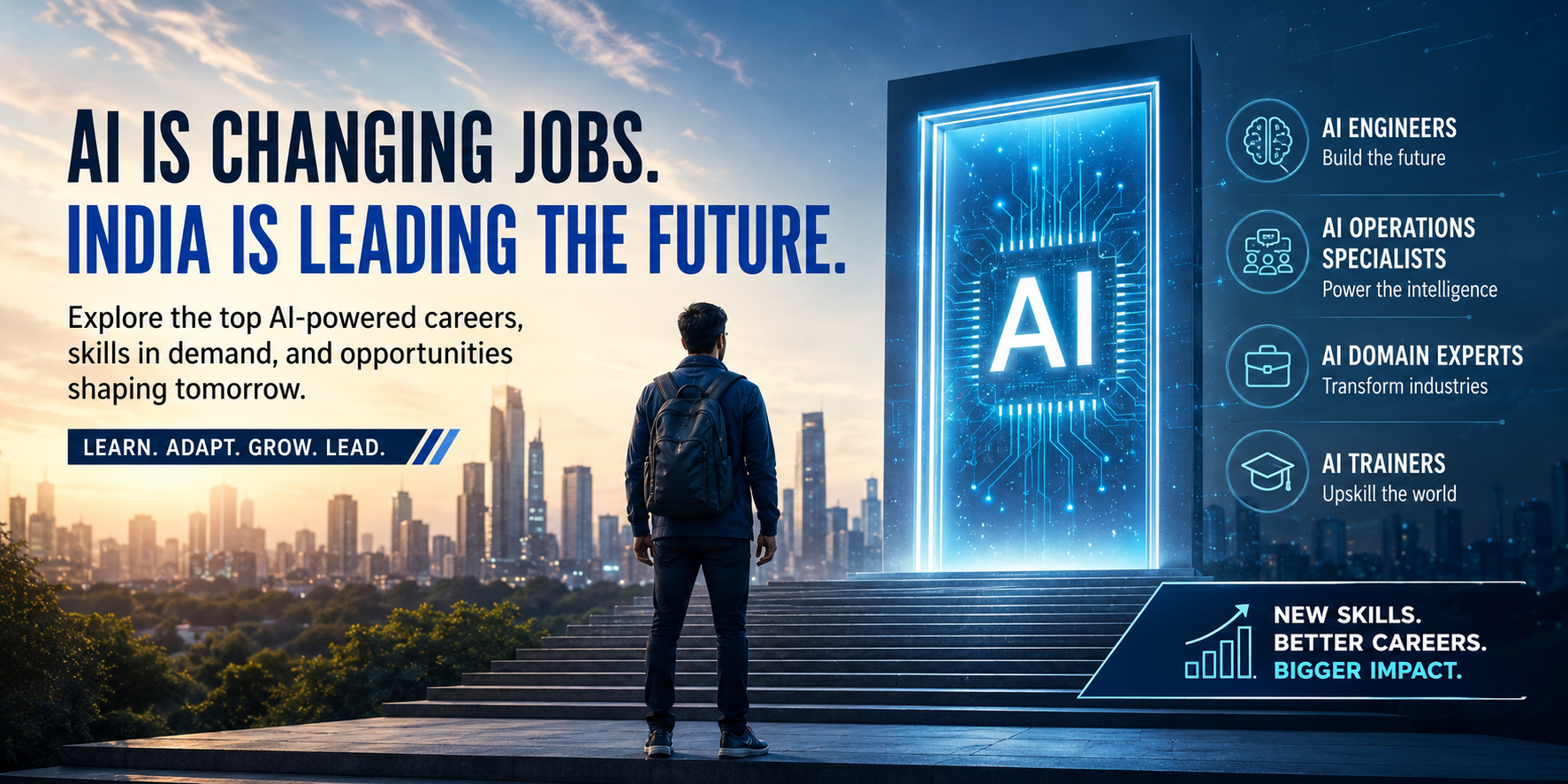
Artificial Intelligence is no longer a futuristic experiment locked inside Silicon Valley labs. It has stormed directly into India’s economic bloodstream, transforming how businesses hire, operate, and scale.
For a country historically powered by IT services, business process management (BPM), customer support, outsourcing, and repetitive operational workflows, the AI revolution is both a disruption engine and a career gold rush.
Some jobs are shrinking. Many are evolving. Entirely new professions are being born almost overnight.
And India? It has quietly become one of the world’s fastest-growing AI talent battlegrounds.
India has become the epicenter of AI hiring growth
According to recent industry reports, demand for AI-related skills across South Asia has more than doubled, with India emerging as the dominant growth hub.
Global Capability Centers (GCCs), startups, SaaS companies, fintech giants, healthcare platforms, and enterprise consulting firms are all racing to integrate AI into their core business operations.
The shift is happening because businesses no longer want AI as a side experiment.
They want AI embedded into customer support, product development, analytics, legal systems, healthcare workflows, operations, cybersecurity, and decision-making itself.
This transformation is creating three powerful waves of employment:
- Core AI engineering roles
- AI operational and support roles
- Specialized cross-domain hybrid careers
Let’s unpack each one.
1. Core technical and infrastructure roles are exploding
India’s technology ecosystem has moved beyond simple ChatGPT wrappers.
Today, enterprises are investing heavily in custom Large Language Models (LLMs), multilingual Indic AI systems, proprietary enterprise copilots, and industry-specific AI platforms.
That means advanced engineering talent has become the crown jewel of the hiring market.
Machine Learning (ML) and Generative AI engineers
These professionals sit at the center of the AI economy.
Their responsibilities include training AI models, fine-tuning LLMs, optimizing neural networks, and deploying scalable AI systems into production environments.
Frameworks like PyTorch, TensorFlow, LangChain, and Hugging Face have become core tools of the modern AI engineer.
Companies are aggressively hiring engineers capable of building predictive AI systems, recommendation engines, autonomous agents, and localized conversational AI for Indian users.
The rise of Generative AI has effectively turned ML engineers into the new-age infrastructure architects of the digital economy.
NLP engineers are becoming critical in India
India’s linguistic diversity creates a massive AI opportunity.
With dozens of major languages and hundreds of dialects, companies desperately need speech-to-text systems, multilingual chatbots, real-time translation systems, and voice assistants optimized for Indian accents and regional languages.
This is where NLP (Natural Language Processing) engineers enter the picture.
These specialists build systems capable of understanding and generating human language across Hindi, Tamil, Telugu, Kannada, Bengali, Marathi, and many more.
As India’s next billion internet users increasingly rely on voice-first interactions, NLP expertise is becoming extraordinarily valuable.
AI infrastructure and data center engineers are the new industrial workforce
AI models are hungry beasts. They require enormous computing power powered by GPUs, cooling systems, networking infrastructure, and hyperscale data centers.
Massive investments are now flowing into AI infrastructure across Mumbai, Bengaluru, Delhi NCR, Hyderabad, and Chennai.
This has created rising demand for engineers specializing in GPU cluster management, cloud infrastructure, server orchestration, networking, and AI hardware deployment.
In many ways, AI data centers are becoming the steel factories of the digital age.
MLOps engineers: the bridge builders of AI
Building AI models is only half the challenge. Deploying them reliably at scale is where things become chaotic.
MLOps engineers specialize in automating AI deployment, monitoring model performance, scaling cloud infrastructure, and ensuring models behave consistently in production.
Think of them as air traffic controllers for AI systems. ✈️
Without MLOps, even brilliant AI models collapse under real-world operational complexity.
2. The rise of the new AI operational layer
One of the biggest myths surrounding AI careers is that everyone needs a PhD in machine learning.
Reality says otherwise.
A massive operational economy has formed around AI systems, creating opportunities for professionals without deeply theoretical computer science backgrounds.
Prompt engineers: the language architects
Prompt engineering emerged almost overnight as one of the most discussed AI careers globally.
These specialists design structured prompts that guide AI systems toward accurate outputs, better reasoning, safer responses, and higher-quality creativity.
They use frameworks like zero-shot prompting, chain-of-thought reasoning, role prompting, and retrieval-augmented generation (RAG).
A well-crafted prompt can dramatically improve coding outputs, marketing campaigns, data extraction, customer support, and research workflows.
Prompt engineers don’t program machines with code alone. They program behavior using language.
AI trainers, annotators, and data curators
AI systems are only as intelligent as the data they learn from.
That has created huge demand for professionals who label datasets, validate AI outputs, clean training data, and audit model accuracy.
India’s large workforce and strong operational ecosystem make it uniquely positioned to dominate this layer of the AI economy.
This sector is rapidly evolving beyond simple annotation into complex reasoning validation, multilingual data curation, and human feedback optimization.
Human intelligence remains deeply embedded inside artificial intelligence. That irony deserves a framed poster. 🧠🤖
AI testing and quality assurance roles
Traditional software testing focused on predictable systems. AI systems are different.
They hallucinate. They improvise. Sometimes they confidently invent nonsense with the energy of a politician during election season.
That’s why AI QA engineers are becoming increasingly valuable.
Their role includes stress-testing AI models, identifying edge cases, detecting hallucinations, validating outputs, and ensuring compliance with safety standards.
AI testing is rapidly becoming its own specialized engineering discipline.
3. Hybrid AI careers are emerging across every industry
AI is no longer confined to technology companies. It is bleeding into healthcare, law, finance, education, consulting, manufacturing, and corporate governance.
This has triggered the birth of hybrid careers where domain expertise matters just as much as technical literacy.
| Traditional role | AI transformation | New hybrid career |
|---|---|---|
| Content writer | GenAI tool mastery | AI content strategist |
| Product manager | LLM integration | AI product manager |
| General manager | AI governance | AI compliance officer |
| Consultant | Workflow automation | AI implementation consultant |
AI compliance and ethics officers
As governments worldwide begin regulating AI systems, companies are racing to avoid data privacy violations, algorithmic bias, intellectual property risks, and compliance failures.
This has created demand for professionals who understand technology, governance, legal frameworks, and ethical AI deployment.
These roles are especially important for Indian companies serving global clients under EU and US regulatory frameworks.
Health tech AI specialists
Healthcare is rapidly becoming one of AI’s most transformative sectors.
Hospitals and medical startups are increasingly using AI for radiology analysis, disease prediction, clinical documentation, patient workflow automation, and diagnostics support.
Health tech implementation specialists act as bridges between doctors, hospitals, AI vendors, and software engineering teams.
This role combines healthcare understanding with technological coordination.
AI literacy trainers are quietly becoming essential
As AI tools enter mainstream workplaces, companies face a huge challenge: how do you upskill millions of existing employees?
This has created demand for AI literacy trainers who teach AI adoption, conduct enterprise workshops, design automation curricula, and help traditional workers integrate AI into daily tasks.
The future workforce won’t just use AI occasionally. It will collaborate with AI continuously.
The real structural shift happening in India
The most important shift is not technological. It is economic.
For years, India’s advantage came from scale, labor arbitrage, repetitive operational execution, and low-cost service delivery.
AI changes that equation dramatically.
The premium is now moving toward critical thinking, problem-solving, creativity, systems design, and domain expertise.
Repetitive coding and manual data entry are becoming increasingly automated.
Meanwhile, professionals capable of directing AI, auditing AI, integrating AI, and strategically leveraging AI are becoming disproportionately valuable.
AI will not simply replace jobs. It will redesign them.
The loudest misconception surrounding AI is that humans and machines are entering a gladiator arena where only one survives.
Reality is more nuanced.
The professionals thriving most in the AI era are not fighting AI head-on. They are using it as a co-pilot.
A developer using AI becomes faster. A marketer using AI becomes more scalable. A doctor using AI becomes more precise. A consultant using AI becomes more analytical.
The future belongs less to people who compete against AI and more to people who learn how to orchestrate it effectively.
Final thoughts
India is entering one of the largest workforce transformations in its modern history.
The AI boom is disrupting traditional service models, reshaping white-collar employment, creating new technical specializations, and redefining what valuable work looks like.
The winners in this new economy will not necessarily be the people with the fanciest degrees.
They will be the people who adapt quickly, learn continuously, think critically, and understand how to combine human judgment with machine intelligence.
Because in the age of AI, the most powerful skill may no longer be writing code alone. It may be learning how to think alongside the machine. 🚀