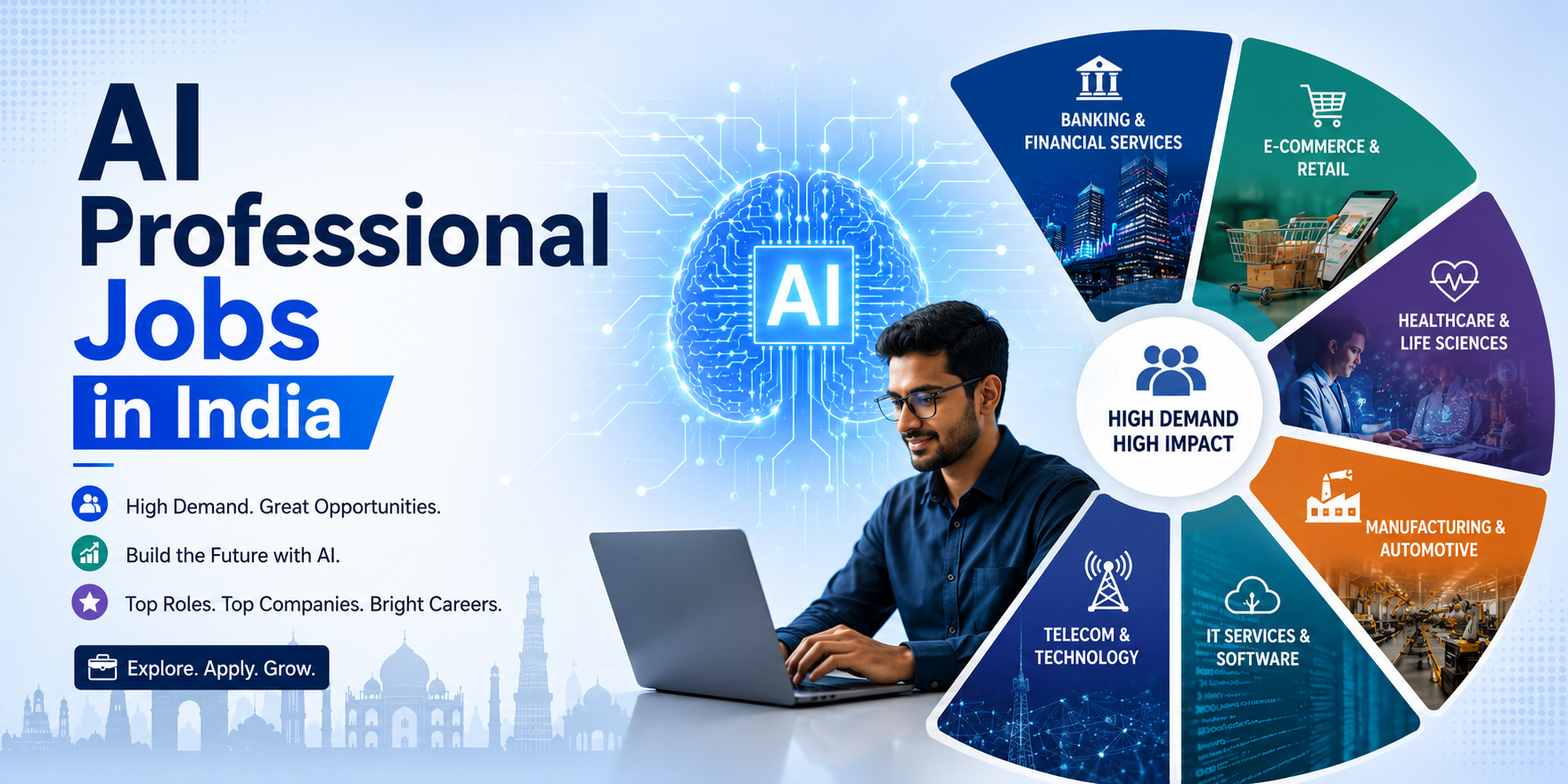
There's a metaphor hiding inside India's AI hiring boom. Think of India's job market as a monsoon-fed river. For decades, it flowed steadily through one channel—IT services. Predictable, deep, reliable. Today, that river has broken its banks. It's flooding fields, factories, hospitals, banks, and even warehouses. AI is the rain that made it overflow.
The numbers are staggering, but numbers alone don't tell the story. The real story is which industries are reaching hungriest for AI talent—and why. Let's walk through them.
The industry breakdown: who's hiring what
Here's how the share of AI job postings in 2025 fell across India's major sectors, according to the foundit Insights Tracker report:
Source: foundit Insights Tracker 2025 / Naukri JobSpeak Jan 2026. Smaller sectors show estimated ranges.
Year-on-year growth: the surprise leaders
Share of total jobs tells one story. Growth rate tells another—and here's where the plot twists beautifully:
BFSI is growing faster in AI hiring than IT itself—a seismic shift that would have seemed implausible just three years ago.
The eight industries, up close
IT & Software Services
37% of all AI roles · Largest employer
DominantTCS, Infosys, Wipro, plus hyperscalers like Google, Microsoft & Amazon. AI is the new delivery layer—every client engagement now demands ML, GenAI, and LLM integration skills.
Banking, Financial Services & Insurance
15.8% share · +41% YoY growth
Fastest growingFraud detection, algorithmic risk models, AI-powered chatbots for 24/7 customer service, and robo-advisory. Fintech is the engine; incumbents are scrambling to keep up.
Global Capability Centres (GCCs)
India hosts 1,800+ GCCs · 2M+ professionals
High priorityNearly half the world's GCCs are in India. By 2026, 75% plan to embed GenAI into daily operations. Demand for prompt engineers, AI architects, and AI governance roles is surging.
Manufacturing
6% share · AI talent expanded 4× in 2025
Rising fastSmart robots, predictive maintenance, AI-powered quality control. By 2025, 90% of large manufacturers had adopted some form of AI. "AI Prompting" is now a baseline factory floor skill.
Healthcare & Pharmaceuticals
~5% share · +38% YoY growth
Hot verticalAI-assisted diagnostics, drug discovery, genomics, and predictive patient analytics. Companies like CureMetrix are building India R&D hubs around computer vision for cancer detection.
Retail & E-commerce
~4% share · +31% YoY growth
GrowingRecommendation engines, demand forecasting, dynamic pricing, and hyper-personalisation. Quick commerce and platform retail are doubling down on AI for last-mile efficiency.
Logistics & Supply Chain
~3.5% share · +30% YoY growth
AcceleratingRoute optimisation, intelligent warehousing, and supply chain prediction. India's booming e-commerce logistics backbone is a hungry employer of ML and operations-AI talent.
BPO / ITeS & Telecom
+21% BPO growth (Jan 2026)
ResurgingThe old BPO model is dead; the AI-augmented BPO is thriving. Conversational AI, NLP-driven automation, and intelligent document processing have triggered a new wave of hiring.
The geography: where the talent lives
India's AI talent map is rapidly expanding beyond the three-city corridor of Bengaluru–Hyderabad–Mumbai. Tier 2 cities are claiming their seat at the table:
Skills that open doors
Across all these industries, a consistent set of capabilities separates the hired from the hopeful. These are the skills employers are paying a premium for right now:
The demand is shifting decisively from knowing AI theory to deploying AI in production. LinkedIn India's Head of Engineering put it plainly: the era of "experimentation" is over. Employers want engineers who can move ideas to execution.
The talent gap: India's productive tension
Here's the uncomfortable truth beneath the optimism: India has 1.3 million AI learners—more than any country on earth. And yet it ranks 89th out of 109 nations in measured AI proficiency. Demand for one million AI professionals by 2026 is projected, with only around half that number currently qualified to fill those seats. That's a 50–55% talent gap.
India is the world's largest AI classroom—and simultaneously, one of its most urgent hiring markets. The race between skilling and demand is the defining tension of this decade.
The government isn't standing still. The IndiaAI Mission has invested ₹10,300 crore in AI infrastructure. The FutureSkills Prime programme has already benefited over 1.58 million candidates. And 174 Industrial Training Institutes across 27 states are being upgraded to include AI curricula—a bet that the next wave of AI talent won't just come from IITs.
What it means if you're building a career
The honest career advice that emerges from all this data is deceptively simple: go where growth outpaces supply. BFSI is growing at 41% but most engineers still think of it as "boring banking." Healthcare AI is red-hot but massively under-staffed with ML talent. Manufacturing is quadrupling its AI headcount with almost no one noticing.
Mid-level salaries for AI roles already range from ₹15–30 LPA, with senior specialists at ₹50 LPA and above. AI Architects command ₹28 LPA as a floor. The profession has, in a remarkably short span, become one of the most financially rewarding in India's knowledge economy.
The city story also matters. Jaipur, Indore, and Mysuru are growing at rates that rival—or exceed—Bengaluru. For those willing to plant a flag in an emerging hub, the competition is lower and the upside considerable.
The river has broken its banks
India's AI hiring story is no longer just a technology story. It's a manufacturing story, a banking story, a healthcare story, a logistics story. The industries that once defined themselves by very different rhythms are all converging on the same urgent need: people who can think with machines and deploy those thoughts at scale. The window for becoming one of those people—irreplaceable, well-paid, and riding the most significant economic wave of a generation—has never been wider. But windows, as anyone in Bengaluru real estate will tell you, don't stay open forever.