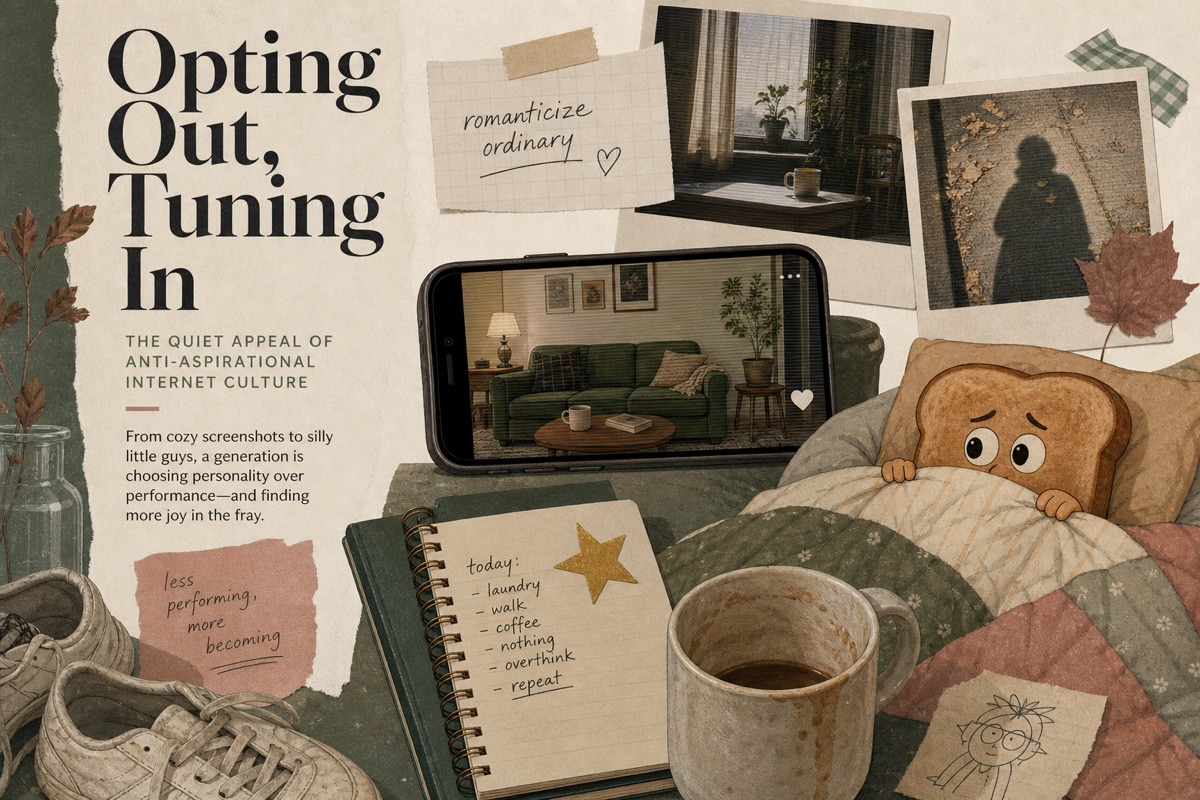
For a decade, social media trained us to want an upgrade. Better skin. Better trip. Better morning routine shot in better light. The feed was a showroom for lives that looked expensive even when they weren’t—and the cultural tax for looking ordinary was invisibility.
September 2026 feels different. Across TikTok and Instagram, creators are romanticising Saturday nights at home, repeating outfits on purpose, handing themselves gold stars for tiny decisions, and giving a packet of biscuits a nightmare about being shared. The joke is soft. The aesthetic is slightly silly. The aspiration, if you can still call it that, is to look like a person rather than a pitch deck.
Relatability doesn’t mean making deliberately boring content. It means noticing when the less polished choice is the more culturally relevant one.
Anti-aspirational content: when ordinary life becomes the flex
The clearest signal is what trend trackers are calling an anti-aspirational turn. Formats such as Kinda Chic celebrate behaviours that would once have been framed as failures of ambition: staying in, wearing the same thing again, choosing the quieter option. Someone Has to Hold It Down does similar work—championing the underrated choice instead of whatever the algorithm has crowned as cool this week.
This is not a sudden outbreak of humility. It is fatigue with a particular kind of performance. After years of hyper-curated routines, viral products, and lifestyle montages that treat every weekday like a brand launch, openly choosing the ordinary option feels like relief. Fashion repeating becomes chic. The comfort meal eaten three nights in a row becomes content. The overlooked destination beats another perfectly staged hotspot.
Importantly, anti-aspiration still needs craft. The camera is still on. The caption still lands. What has changed is the status hierarchy: the win is no longer “look richer.” The win is “look recognisable.”
Whimsy
Surprise, silliness, and low-stakes play—products with feelings, soft mystery, jokes that refuse to optimise.
Nostalgia
90s and 00s textures, archive fashion, older songs finding new ears—emotion without a new upgrade cycle.
Small wins
Gold stars for finishing a product, checking the fridge, taking a short walk—not for becoming a new person.
Niche humour
Specific jokes that feel like inside language beat mass “Monday again” relatability every time.
Small wins instead of huge transformations
If the 2010s belonged to haul culture and the early 2020s to glow-up mythology, 2026’s social mood is partial to the Gold Star Behaviour instinct: celebrate the tiny habit that deserves recognition. Outfit repeating. Admitting you’re wrong. Buying less. Finishing a product before opening another. Taking the twenty-minute walk on the day a full workout wasn’t happening.
That shift matters because it rewrites the story brands and creators tell about progress. The product is not always the achievement. The behaviour already happening in someone’s life—the fridge check, the quiet reset after summer, the “lock in” routine as September returns—becomes the plot. Huge transformations still circulate, but they no longer monopolise the emotional centre of the feed.
There is a quiet ethics in this, too. When social rewards people for consuming less loudly, it nudges culture away from endless acquisition as proof of living well. Whether that holds commercially is another question. Culturally, the applause track has changed.
Whimsy on TikTok: specificity and products with nightmares
Anti-aspiration alone would risk becoming bland. Whimsy is the spice. Formats like It Was a Bad Dream—where an everyday object approaches its worst fate, then wakes under the covers relieved—sound childish until you notice what they unlock: products as characters. A white trainer terrified of mud. A suitcase panic at an oversized sticker. A biscuit fearing the sentence “shall we share?”
This is advertising’s old trick—anthropomorphism—returned through a sillier door. Traditional product marketing lists features. Whimsical social lets objects have desires and dread. In a feed where AI can polish anything into generic beauty, a slightly ridiculous personality reads as human-made.
The same logic drives niche humour. I Try to Act Normal works because the caption is surgically specific: not “when it’s Monday,” but “when you’ve already taken your shoes off and someone suggests another pub.” Mass relatability has become noise. Specificity feels like being seen.
| Cooling off | Heating up |
|---|---|
| Hyper-curated lifestyle montages | Kinda Chic ordinary choices and soft stays-at-home flexes |
| Haul culture and endless newness | Gold stars for finishing, repeating, and buying less |
| Universal “relatable” captions | Hyper-specific jokes that only the right audience fully gets |
| Feature dumps and polish for polish’s sake | Whimsical product personalities and low-stakes surprise |
90s and 00s nostalgia as a soft landing
Whimsy rarely travels alone. It arrives wearing yesterday’s jacket. September’s cultural calendar—Fashion Month’s archive instincts, late-90s film moods, multi-generational fandoms, older music rediscovered through edits—keeps handing social a palette of recognisable feelings. The past becomes texture: richer autumn shades, cosy interiors, witchy seasonal aesthetics, Britpop echoes, packaging and ads pulled from a brand’s own hard drive.
Nostalgia works here because it offers emotion without demanding a new self. You don’t have to become someone richer, thinner, or more optimised. You can borrow a mood that already existed—an Owens-sisters autumn, a street-style silhouette, a song your parents played—and remix it. For younger audiences, a twenty-year-old archive clip can feel genuinely new. For older ones, it feels like home.
That is why nostalgia pairs so cleanly with anti-aspiration. Both resist the tyranny of the upgrade. Both say: the interesting thing might already be in the room.
The catch: even anti-aspiration can become a costume
Every cultural correction invents its own performance. Care too loudly about being unbothered by cool, and you reinvent cool. Romanticise the ordinary too hard, and “staying in” becomes another aesthetic checklist—linen, candle, gold star, caption, done.
The healthier version of this shift is not a shopping list of whimsical props. It is permission: to be specific, to be slightly silly, to stop treating every post like a personal brand launch. Brands that understand the mood will celebrate behaviours their audiences already feel good about. Creators who understand it will keep the joke narrow enough to feel true. Audiences who understand it will sense when “anti-aspirational” is just another polished product in a thrifted outfit.
The strongest content isn’t trying to impress everyone. It’s trying to recognise someone.
What it means
Put simply: social in late 2026 is rewarding people who refuse to look like they are auditioning. Whimsy restores play. Nostalgia restores warmth. Anti-aspirational formats restore scale—small enough that a real life can fit inside the frame.
This sits beside other cultural currents this season: conversations about postpartum mental health and phone-free schools, and the longer shift toward caring loudly over detached cool. The through-line is sincerity without the old demand that sincerity look impressive. Online, that can look like a gold star for finishing the shampoo. Offline, it might look like choosing the ordinary Saturday and meaning it.
Glow-ups still happen. They just no longer own the plot. Sometimes the plot is a biscuit that had a bad dream—and woke up, somehow, more memorable than a perfect morning routine.
Frequently asked questions
What is anti-aspirational content?
Anti-aspirational content romanticises ordinary choices—staying in, repeating outfits, celebrating tiny habits—instead of hyper-curated lifestyles, haul culture, or dramatic glow-ups. It still performs on camera; it just refuses to look impressive.
Why is whimsy trending on TikTok and Instagram in 2026?
After years of algorithmic aspiration and hyper-personalised feeds, audiences are hungry for surprise, silliness, and low-stakes play. Formats that give products personalities, niche jokes, or soft mystery feel fresher than another polished lifestyle montage.
What formats capture the anti-aspirational mood?
September 2026 formats such as Kinda Chic, Someone Has to Hold It Down, Gold Star Behaviour, I Try to Act Normal, and It Was a Bad Dream all reward specificity, small wins, and slightly silly storytelling over mass relatability and perfection.
How does nostalgia fit into this shift?
90s and 00s aesthetics—archive fashion, older music finding new audiences on TikTok, film moods that revive cosy late-90s worlds—offer emotional texture without requiring a new lifestyle upgrade. Nostalgia becomes a soft landing from constant optimisation.