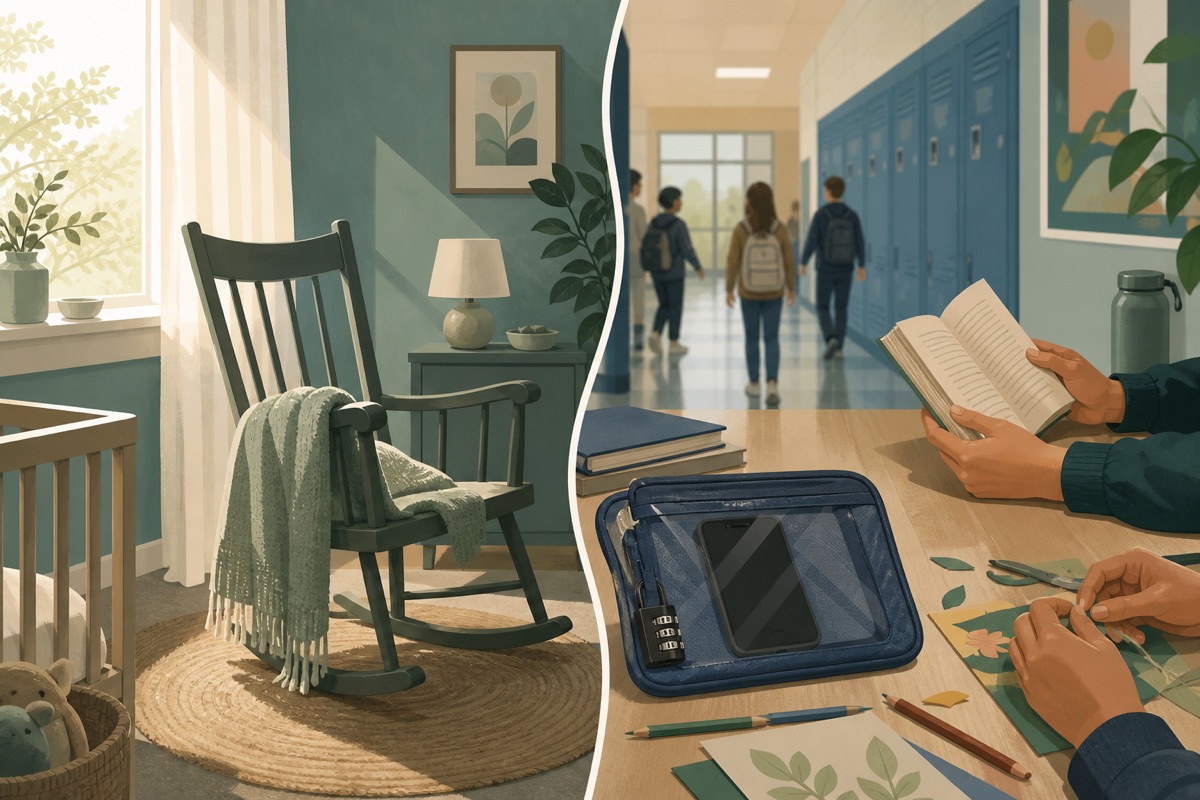
September has a way of resetting the calendar: new school years, new routines, the soft return of structure after summer’s looseness. In 2026, that reset is colliding with two conversations that sound unrelated until you listen carefully. One is about mothers—and fathers—in the months after birth. The other is about students walking into campuses where the phone stays in a pouch, a locker, or at home.
Both are arguments about care. Not the branded kind. The practical kind: who gets validated, who gets protected, and what fills the hours when the old default—ignore the mother’s distress, or hand the child a screen—no longer feels acceptable.
Culture is not only what we celebrate. It is what we finally refuse to minimize.
Postpartum mental health and the fourth trimester
For a long time, the story after childbirth was written almost entirely around the infant. The person who gave birth was expected to recover quietly: feed, function, bounce back. The “fourth trimester”—the roughly twelve weeks after delivery—was medically and culturally treated as a blurry extension of pregnancy rather than a lifestage with its own risks, needs, and language.
That framing is cracking. High-profile coverage of postpartum depression and postpartum psychosis has pushed a care gap into public view: the gap between how often these conditions occur and how little structured support many families actually receive. The World Health Organization estimates that about 10% of pregnant women and 13% of women who have recently given birth experience a mental disorder, primarily depression—with higher rates reported in many developing countries. In the United States, estimates often land closer to one in five women experiencing mental health issues in the postpartum period.
The cultural shift is not only clinical. It is narrative. Mothers are more willing to speak about taboo subjects; partners are entering the conversation through paternal postpartum depression, leave policies, and flexible work; and campaigns that once sold only cuteness are beginning to show the mess of recovery—meals, laundry, bleeding, sleep deprivation, and the awkward work of asking for help.
Recognition
Postpartum as a distinct lifestage—not only infant care with a mother attached.
Validation
Honest talk about fear, depression, and psychosis instead of soft-focus silence.
Support
Practical help: networks, leave, recovery products, nutrition, sleep, and advocacy.
Systems
Pressure on healthcare and policy, not only on individuals to “stay positive.”
There is a commercial layer to this, and it is worth watching with a clear eye. Recovery kits, postnatal vitamins, fitness “return” programs, and SMS tools that help parents activate a support network can be useful. They can also become another optimization burden—“heal correctly, buy correctly, perform recovery correctly.” The cultural opportunity is not a prettier shopping aisle. It is treating postpartum mental health as real health: underfunded in many systems, uneven across race and class, and too often still treated as private failure rather than public responsibility.
Phone-free schools and the digital wellbeing void
If postpartum care is about making invisible suffering visible, phone-free schools are about making constant stimulation optional again. According to UNESCO’s Global Education Monitoring work, roughly 58% of countries now enforce national restrictions on mobile phones in schools—up from about 24% in mid-2023. In the United States, most states have moved toward bans or tight limits. Whatever one thinks of the politics, the scale is hard to ignore.
Young people themselves often name the awkward next question. If phones leave the school day, what replaces the click and swipe? Many students grew up with tablets in primary school and social platforms as a social nervous system. Removing the device does not automatically restore attention, friendship, or calm. It creates a void.
That void is where culture is experimenting. Craft carts rolling through campuses. Detox rooms with books and fidget tools. Disposable-camera scavenger hunts. Repair workshops at retailers that teach sewing and mending. Slow hobbies, run clubs, deep reading—analog habits that look quaint until you remember how much of childhood was colonized by the notification stack.
| Claim | What the evidence and culture suggest |
|---|---|
| Bans reduce distraction | Strict policies can cut daytime phone use. That part is relatively clear. |
| Grades jump overnight | Large U.S. studies find little immediate academic lift. Benefits, if any, arrive slowly. |
| Wellbeing improves instantly | Early months can feel worse—more discipline friction, lower reported wellbeing—before later recovery. |
| The real design problem | What students do with reclaimed hours: connection, boredom, crafts, reading—or restless substitution. |
Recent research on pouch-style bans across thousands of U.S. schools is a useful cold shower. Phones go down. Test scores do not magically soar. Suspensions can rise at first. Subjective wellbeing can dip, then rebound and even improve over a few years. The lesson for culture is not “bans are useless.” It is that digital wellbeing is a long adaptation, not a press release.
Students co-authoring “digital wellness” curricula make the smarter argument: they are not always anti-tech. They want balance taught as a skill—how to live with tools that are both useful and inescapable. That framing matters for younger users especially. A ban without literacy is a fence. A ban with literacy is a rehearsal for adulthood.
The shared thread: protection without performance
Put the two stories side by side and a pattern appears.
Postpartum culture is learning that care cannot be reduced to infant milestones. Phone-free school culture is learning that attention cannot be reduced to confiscation. In both cases, the public is rejecting a thin script: mothers should be grateful and fine; teens should be reachable and productive. What people want instead is room—to recover, to be bored, to ask for help, to build habits that are not optimized for an algorithm’s retention curve.
There is a risk on both sides of turning care into content. Maternal vulnerability can become a brand aesthetic. Screen-free hobbies can become another identity performance—“look how analog I am.” The healthier version of either trend is quieter. Meals delivered without a photoshoot. A craft done without a streak. A conversation with a clinician. A lunch table that does not need documenting.
Digital wellbeing, at its best, is not a detox aesthetic. It is the freedom to be unreachable long enough to become a person again.
What comes next
For families in the fourth trimester, the near future looks like more open talk, more product and service experimentation, and—if advocacy holds—more pressure on health systems to treat postnatal mental health as infrastructure, not afterthought. For schools, it looks like a worldwide experiment in reclaiming the school day, with mixed early results and a growing market for whatever comes after the swipe: books, tools, clubs, repair skills, and communities that do not live only in group chats.
GeekFlux’s interest is not in scolding mothers or students. It is in noticing when culture finally names a need that was always there. After birth, people need more than congratulations. After phones leave the classroom, young people need more than empty pockets. Both conversations are really about the same scarce resource: attention that is protected long enough for care to happen. That thread also runs through the season’s anti-aspirational turn on social—less performance, more room to be human—and the longer cultural shift away from detached cool.
If 2026 has a cultural mood, it may be this: less pretending that silence equals strength, and less pretending that connection equals a glowing rectangle.
Frequently asked questions
What is the fourth trimester, and why is it getting attention?
The fourth trimester refers to the roughly twelve weeks after childbirth. It is increasingly treated as a distinct lifestage—not only as infant care—because postpartum depression, anxiety, and psychosis remain common, under-supported, and culturally minimized relative to the baby’s needs.
How common are perinatal mental health conditions?
According to the World Health Organization, about 10% of pregnant women and 13% of women who have recently given birth experience a mental disorder, primarily depression—with higher rates reported in many developing countries.
How widespread are school phone bans in 2026?
UNESCO’s Global Education Monitoring Report finds that about 58% of countries now have national restrictions on mobile phones in schools, up from roughly 24% in mid-2023—one of the fastest-spreading education policies of the decade.
Do school phone bans immediately improve student wellbeing?
Large U.S. research suggests benefits are not instant. Strict bans reduce daytime phone use, but the first year can bring more discipline issues and lower reported wellbeing; by later years, wellbeing often recovers and can improve beyond baseline. The cultural question is what fills the void once the phone is gone.