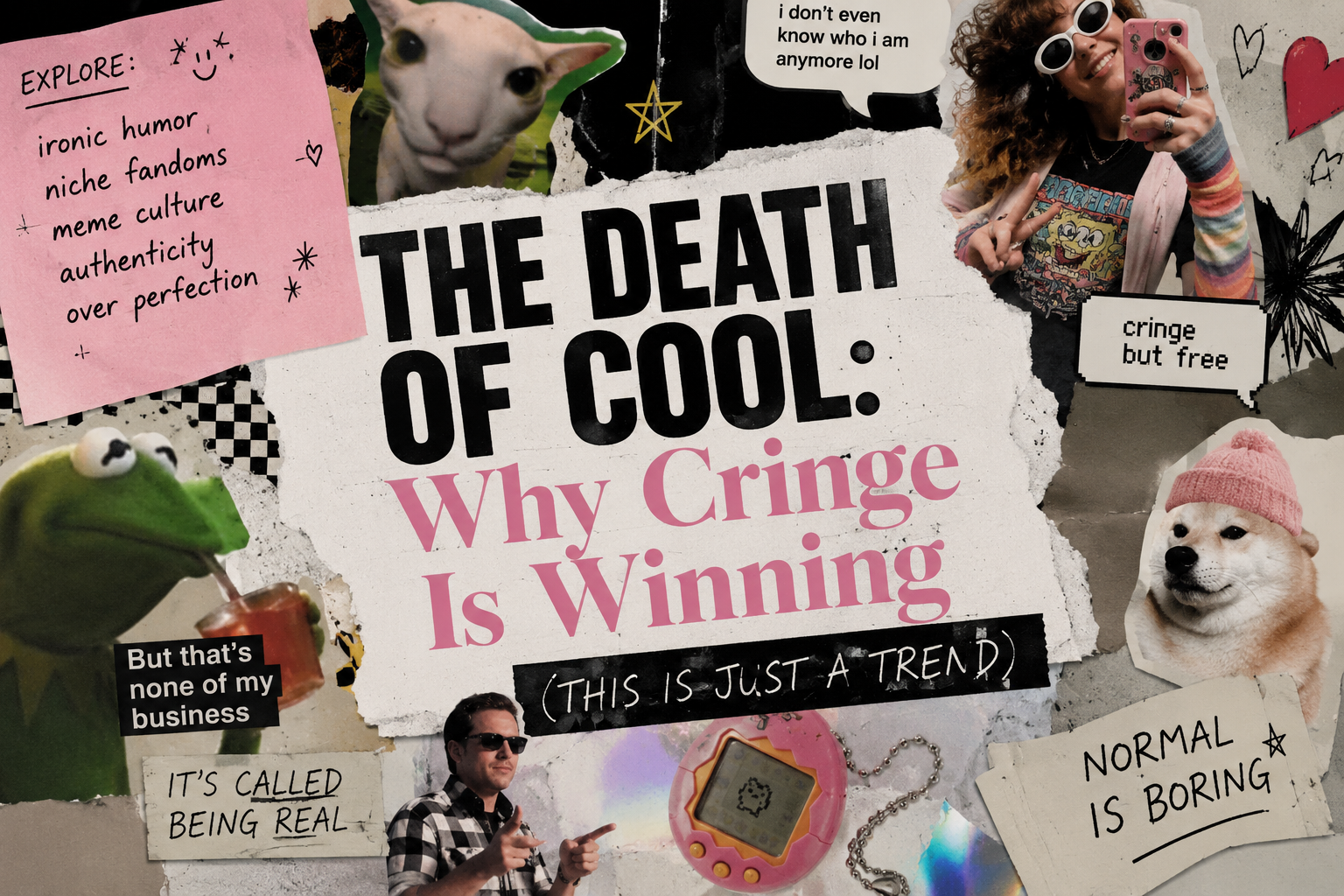
There was a time when cool was everything. You either had it or you didn't. And if you didn't—if you cared too much, laughed too easily, wore your enthusiasms too openly—you were something far worse than unpopular. You were cringe.
That time is over. Something has quietly, irrevocably shifted in how we perform identity on the internet—and across culture at large. Cool, as we understood it, is dead. In its place? Something messier, louder, weirder, and far more human.
Irony is a symptom of late-capitalist nihilism, and cringe is the antidote to that. — Joshua Citarella, online-culture researcher
Cool's long reign—and quiet collapse
For decades, cool operated on a single principle: detachment. To be cool was to appear effortless. Unmoved. Unreachable. It was James Dean not caring, rock stars arriving late, critics who only loved things with a knowing smirk. Cool was the studied performance of not performing.
By the time social media arrived, cool had calcified into a set of unspoken rules. Don't try too hard. Don't admit you like things too much. Keep everything at ironic arm's length. This reached its peak sometime in the mid-2010s, when a particular brand of detached, edgy nihilism colonized the internet—the golden age of the "edgelord," when sincerity was the cardinal sin.
| Era | What shifted |
|---|---|
| Early 2010s | Peak irony era. "Try-hard" was an insult. YouTubers built millions of followers by mocking creators who were too earnest or enthusiastic. |
| 2016–19 | Nihilism reigns. Meme culture turned deeply detached. Caring about things—politically, artistically, personally—felt naïve. |
| 2020–21 | The pandemic pivot. Everyone moved online. TikTok rewarded spontaneity and vulnerability. Free from the social gaze, people started being themselves. |
| 2023–now | Cringe ascends. Niche fandoms, unhinged humor, and authentic passion go mainstream. Being genuinely enthusiastic becomes radical—and resonant. |
Then the pandemic hit. And locked indoors, something broke open.
The great unlocking: cringe goes mainstream
When physical social spaces collapsed in 2020, so did the enforcement mechanism of cool. You couldn't be mocked at school for your weird hobby if school didn't exist. The social cost of vulnerability plummeted. And into that gap streamed something that had been suppressed for years: genuine, embarrassing, beautiful enthusiasm.
TikTok was the delivery mechanism. Unlike Instagram's aspirational gallery of perfect lives, TikTok rewarded the raw and the real—the off-key covers, the niche obsessions, the unguarded moments of joy. Suddenly, people who had spent years hiding their love of obscure anime, medieval history, or competitive axe-throwing found not just an audience but a community.
Ironic humor
Humor that layers sincerity inside absurdity—laughing at the meme and meaning it at the same time.
Niche fandoms
Communities built on hyper-specific passions. The nicher the love, the deeper the belonging.
Meme culture
Remix and reuse as creative language—pop culture deconstructed and reassembled to express emotion.
Authenticity
The radical act of caring: not performing relatability, but actually being vulnerable and real.
The strange alchemy of ironic humor
Here is where things get philosophically interesting. The death of cool did not produce naive, wide-eyed sincerity. It produced something more sophisticated: post-irony. A mode of communication that expresses something authentic and sincere through an ironic tone—meaning it simultaneously means what it says and knows that it's funny for meaning it.
Think of the memes that define this era. A Jet2 airline jingle played over footage of total personal disaster. Jon Hamm dancing with confident awkwardness, repurposed endlessly. The "Gen Z Stare"—a blank, unamused expression that manages to communicate more emotional depth than a thousand earnest Instagram captions. These aren't just jokes. They're a language: one that processes collective anxiety, longing, and humor without committing to any single register.
Researchers call the deepest layer of this meta-irony: a message that appears to make a statement but has no fixed underlying meaning—leaving the interpretation deliberately open. It sounds chaotic. It is chaotic. That's the point. In a world where every sincere statement can be screenshot and weaponized, layered irony is both armor and art.
If Instagram showcases perfect, untouchable lives, memes bring us back to images that are real, imperfect, ironic—and full of authenticity.
Niche is the new mainstream
Parallel to the rise of ironic humor is a quieter revolution: the rehabilitation of the nerd, the superfan, the obsessive. What once was the social liability of the deeply uncool—caring too much about a very specific thing—has become a superpower.
The economics of the internet explain part of it. When entertainment culture fragments into infinite niches, there are fewer shared cultural touchpoints. The mass-market "cool" that depended on everyone watching the same TV and listening to the same radio dies when everyone's algorithm is different. What replaces it is something smaller and more intense: the fandom, the subculture, the community that speaks in references only its members understand.
And the research bears this out. Studies find that people feel deeply seen inside niche communities in ways that mass culture never delivered. The thrill isn't the content—it's the recognition of being known by strangers who share your specific, unlikely love. Once niche, now belonging. Once embarrassing, now identity.
The real revolution: caring as radical act
Step back from the memes and the fandoms and the irony, and a single through-line emerges: the culture has shifted its valuation of caring. For a decade, the coolest thing you could be was unbothered. Now, the most resonant thing you can be is genuinely, vulnerably, unashamedly enthusiastic.
Content creators who spent years crafting ironic detachment are watching audiences flock toward creators who simply mean it. The Swifties go full-costume to concerts without apology. Anime fans wear their passion as a badge. Gen Z founds nonprofits, makes earnest videos about things they love, builds communities around ideas they actually believe in—and none of it is performed for cool points, because cool points no longer exist as currency.
One media professional put it plainly: "It was not cool to have beliefs or feel strongly about anything. It was a general environment of hopelessness that people adopted as a way of insulating themselves from failure. To see people who really do enjoy things and make themselves vulnerable is a really radical thing."
Even brands have read the room. Ryanair turned its reputation for cramped seats into a TikTok meme factory, joking about its own limitations rather than hiding them. Duolingo's absurdist owl became a cultural phenomenon by committing fully to chaotic, self-deprecating humor. The brands that survive Gen Z's cringe radar are the ones that abandoned the performance of perfection—because Gen Z can smell polish from a mile away, and it smells like dishonesty.
So what killed cool?
Cool died because it was always a performance—and performances require an audience willing to be impressed. When the audience started comparing notes online and realized everyone was performing, the theater collapsed. What filled the void wasn't its opposite—reckless sincerity—but something more nuanced: the freedom to care about things with full awareness of how caring looks.
That's what cringe culture, at its best, actually is. Not the absence of self-awareness, but self-awareness cranked so high it loops back around into something genuine. It's the person who posts their extremely niche hobby knowing it's embarrassing and posting it anyway. It's the meme that is technically making fun of something and also completely means it. It's the fandom that knows their enthusiasm is excessive and has turned that excess into the whole point.
Cool told us to want less, reveal less, feel less. Cringe says: want everything, loudly, in public, and dare someone to make you feel bad about it.
In that sense, cringe isn't the death of dignity. It's the birth of a better kind of cool—one that doesn't need you to pretend.