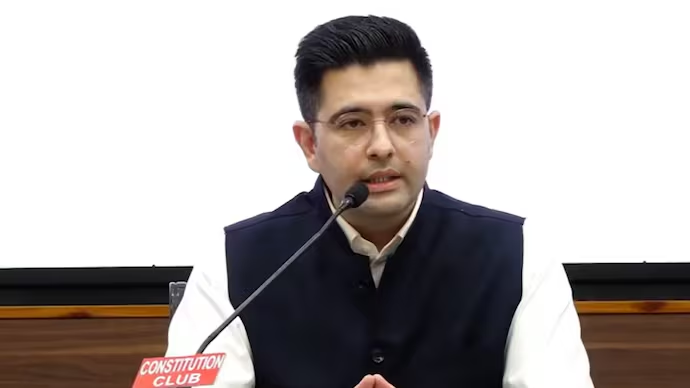
The Meteor Rise: From Anti-Corruption Roots to Parliament
Raghav Chadha was not just another politician. He emerged as one of the youngest faces of the Aam Aadmi Party, often seen as a polished, articulate strategist close to Arvind Kejriwal.
From being part of the anti-corruption movement to becoming a Rajya Sabha MP, his journey felt like a well-written script. A calm demeanor, sharp economic arguments, and a reputation as a policy-minded leader made him stand out in India's noise-heavy political arena.
But scripts, like politics, are often rewritten mid-act.
The Big Break: Why He Quit AAP
April 24, 2026 rewired the narrative.
Chadha resigned from AAP and joined the Bharatiya Janata Party, taking along six other Rajya Sabha MPs. This was not merely a resignation. It was a coordinated political migration that immediately shifted the parliamentary conversation.
What triggered it?
- Internal rift with leadership: reports suggested growing friction between Chadha and AAP's top command.
- Removal from key role: he had earlier been removed as deputy leader in Rajya Sabha, signaling cracks in trust.
- Ideological differences: Chadha hinted that the party had drifted from its founding principles.
His own framing was dramatic: he felt like the "right man in the wrong party."
The Strategy Behind the Move
This was not impulsive. It was almost mathematical.
Under India's anti-defection law, two-thirds of MPs are required to legally merge with another party without disqualification. Chadha ensured that threshold was met by moving as part of a group.
Think of it like a carefully timed domino setup. One push, and the entire line falls in legal symmetry.
Political Reactions: Applause, Accusations, and Aftershocks
The reactions were predictably explosive.
AAP called it backstabbing and accused BJP of engineering the split. BJP welcomed the move, framing it as a shift toward better leadership alignment. Critics, meanwhile, labeled it a classic case of political opportunism.
Regardless of framing, the move has shaken AAP's internal structure, especially with elections looming in Punjab.
What This Means for Indian Politics
This is not just about one leader switching sides. It points to three wider shifts:
- AAP's stability under question. A party once known for tight-knit leadership now faces visible fractures.
- BJP's expanding influence. Absorbing multiple MPs strengthens both parliamentary numbers and narrative momentum.
- A new chapter for Chadha. From party loyalist to political defector, his public image now enters a more complex, debated space.
The Human Layer Behind the Headlines
Beyond strategy and seat math, there is a human arc here.
A politician who spent years building a party has chosen to walk away from it. That decision is rarely just tactical. It carries ambition, disagreement, and perhaps disillusionment stitched together.
Chadha's journey now resembles a character stepping out of one storyline and into another, with the audience unsure whether to applaud or question.
Final Thoughts
Raghav Chadha's move is less like a single headline and more like the opening of a new season in Indian politics.
Will he thrive in his new political home? Will AAP recover or fragment further? And most importantly, will voters see this as evolution or betrayal?
Politics, after all, is a long game. This move may have just reset the board.