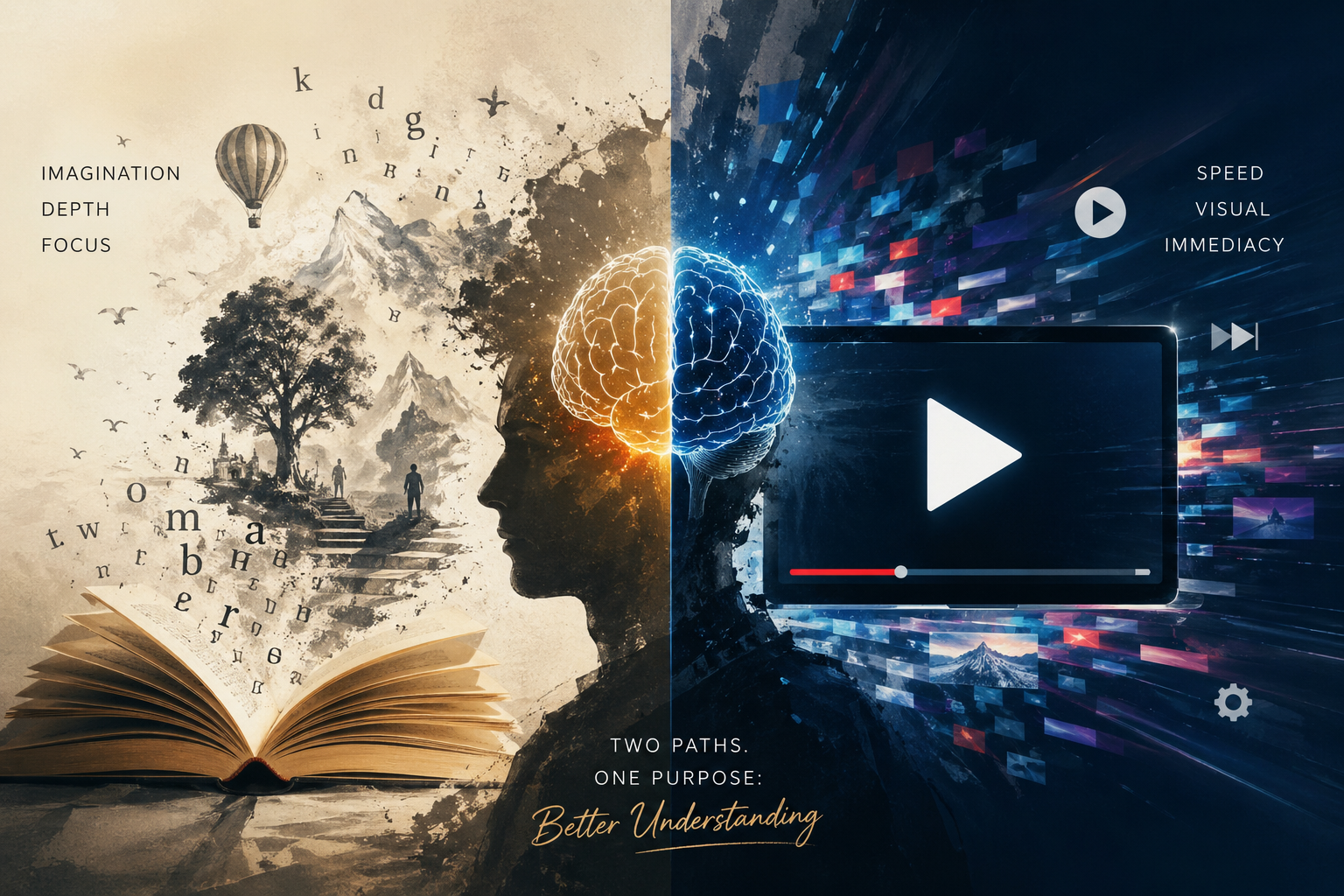
Let’s wander through both doors.
The Slow Fire of Reading
Reading a book is less like consuming information and more like building it. The author provides the scaffolding, but you furnish the house.
Words on a page are inert until your mind animates them. A forest described in a paragraph becomes your forest. A character’s voice becomes your interpretation of tone, rhythm, and silence. Reading is an act of co-creation.
This has a profound side effect: depth.
Books demand patience. They resist interruption. They ask you to sit with ambiguity, to rewind, to reflect. In a world addicted to velocity, reading trains a rare muscle: sustained attention.
And in that attention, something quietly transformative happens. You begin to think in layers. You notice nuance. You learn to tolerate complexity without rushing to conclusions.
Reading is not just intake. It is internalization.
The Electric Pulse of Video
Watching a video, on the other hand, is like stepping into a fully constructed world. The lighting is chosen, the pacing is engineered, the emotions are guided. It’s immersive in a way reading rarely is.
Video excels at immediacy.
A concept that might take pages to describe can be demonstrated in seconds. A facial expression, a pause, a shift in tone—these human elements carry meaning that words often struggle to capture.
It’s also more accessible. After a long day, when mental energy is scarce, video meets you where you are. It doesn’t demand; it delivers.
And for many kinds of learning—procedural, visual, experiential—video can be extraordinarily effective. Watching someone solve a problem, build something, or explain a system in motion can accelerate understanding.
Video is not passive, but it feels effortless.
The Hidden Trade-Off
Here’s where things get interesting.
Reading strengthens imagination but requires effort.
Video reduces effort but can outsource imagination.
When you read, your brain fills in gaps. When you watch, those gaps are already filled.
Neither is a flaw. But over time, they shape cognition differently.
Heavy readers often develop sharper analytical thinking, stronger memory retention, and a greater ability to sit with complex ideas. Frequent video consumers may process information faster, recognize patterns visually, and grasp concepts quickly—but sometimes with less depth.
Think of it this way:
- Reading is like cooking from scratch.
- Video is like being served a beautifully plated dish.
Both nourish you. But only one teaches you how to cook.
Attention: The Currency Both Compete For
At the heart of this comparison is a single, invisible resource: attention.
Books require you to invest attention upfront. Videos often capture it instantly.
But what we invest in, we tend to value differently.
When you spend hours with a book, wrestling with ideas, the knowledge feels earned. It sticks. It integrates. It becomes part of how you think.
Videos, especially in the age of endless scrolling, risk becoming ephemeral. Insightful in the moment, forgotten by evening.
This is not a limitation of video itself, but of how we consume it.
The Myth of Choosing One
Framing this as “reading vs watching” misses the real opportunity.
The most effective learners don’t choose one door. They walk through both—intentionally.
They might:
- Watch a video to grasp a concept quickly
- Read a book to deepen and challenge that understanding
- Revisit the video with new context
- Reflect, annotate, and connect ideas across both formats
In doing so, they combine speed with depth, clarity with contemplation.
When to Read, When to Watch
If you’re looking for guidance, consider this:
Choose reading when you want:
- Deep understanding
- Critical thinking
- Long-term retention
- Mental discipline
Choose video when you want:
- Quick orientation
- Visual demonstration
- Emotional engagement
- Low-effort learning
And when something truly matters?
Use both.
A Final Thought
Books whisper. Videos perform.
One asks you to lean in; the other reaches out to grab your attention.
But the real question isn’t which is better. It’s this:
How do you want to think?
Because the medium you choose doesn’t just change how you learn.
It changes who you become as a learner.
And over time, that changes everything.