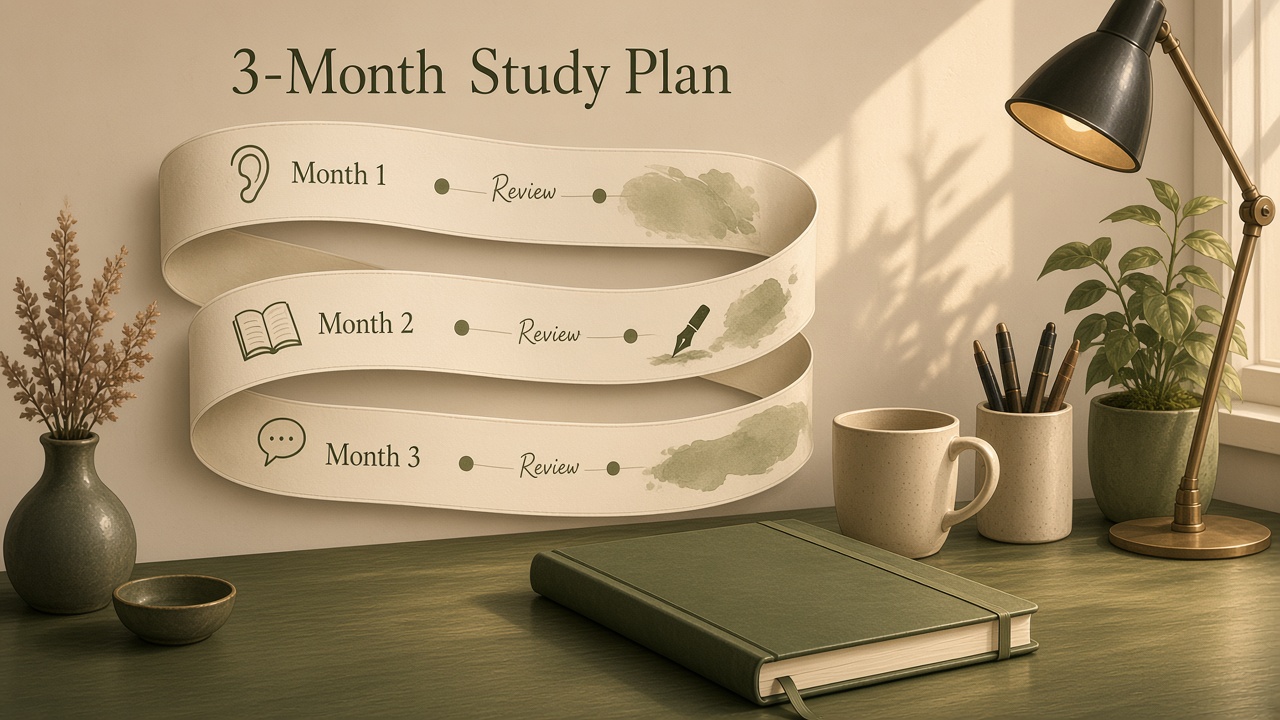
Why three months beats three weeks
IELTS is four exams wearing one brand. Cramming Reading tricks does not fix Writing coherence or Speaking fluency. Spaced practice across skills is slower and less glamorous than '999 vocabulary words' lists — and it works.
Month 1: Diagnose, do not decorate
Take a baseline mock under exam conditions. Build an error log with categories: paraphrase failure, time management, task response, pronunciation. Your plan targets the log, not your anxiety.
Month 2: Timed retrieval
- Listening: replay without transcript, then check — retrieval, not passive replay.
- Reading: timed passages; summarise main argument closed-book.
- Writing: plan Task 2 essays from memory; write introductions under 8 minutes.
- Speaking: record Part 2 monologues; listen back for hesitation patterns.
Schedule IELTS skills like subjects
Revu tracks Listening, Reading, Writing, and Speaking reviews so each band skill gets spaced practice.
View on App Store →Month 3: Mocks as memory events
Full mocks every 7–10 days with spaced debriefs. Vocabulary learned without retrieval evaporates in Task 2. Review words in sentences you write, not lists you highlight.
Weekly rhythm (sample)
| Day | Focus | Retrieval finish |
|---|---|---|
| Mon | Reading timed + error log | Summarise two passages closed-book |
| Tue | Writing Task 2 | Outline next essay from memory |
| Wed | Listening sections | Transcript-free replay |
| Thu | Speaking + vocab in context | Record and self-correct |
| Fri | Mixed weak skills | 5-minute brain dump of week's errors |
Band scores follow the skills you retrieve on schedule — not the apps you download the night before.