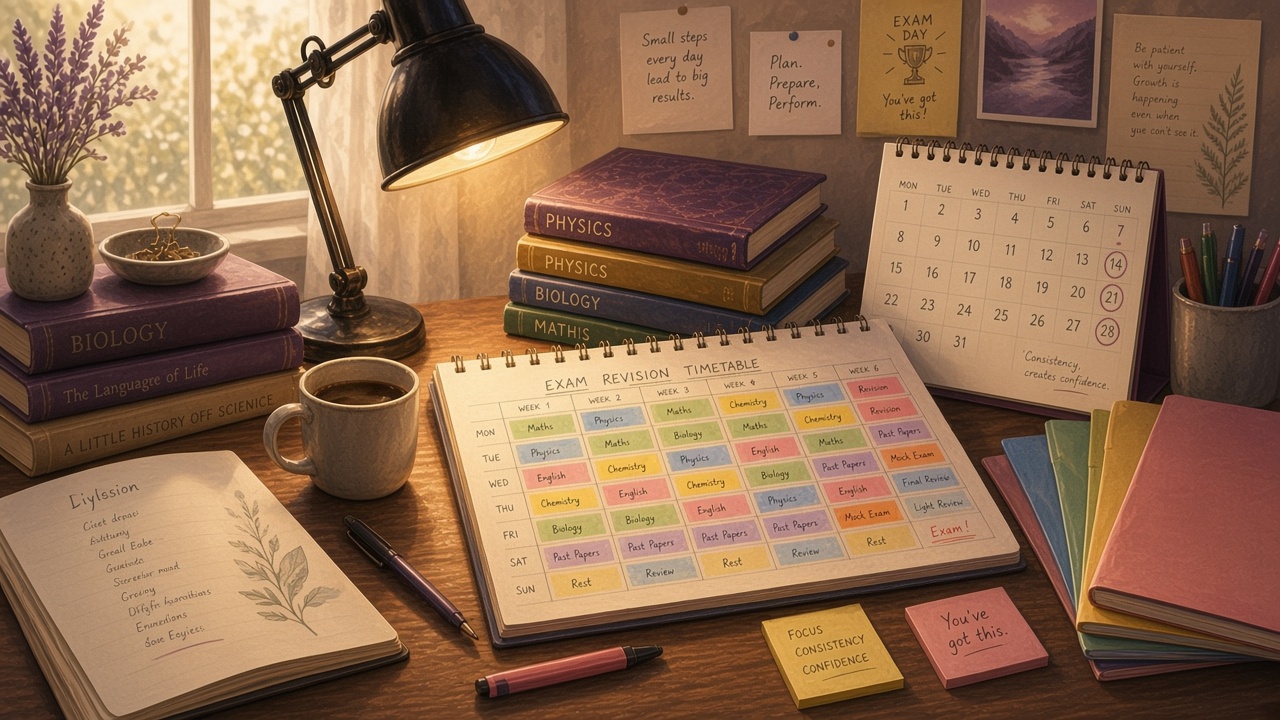
Why GCSE revision fails the usual way
Most Year 11 students treat revision as a volume problem: more hours, more highlighters, more panic. Memory science disagrees. Massed study produces fluent recognition that collapses under exam stress. Spaced retrieval — pulling facts and methods from memory on a schedule — is slower and less flattering, but it survives.
GCSEs reward breadth. That makes spacing non-negotiable. You cannot cram nine subjects in the final fortnight and expect transfer on unfamiliar questions.
Step 1: Build a topic map, not a mood board
Start with the specification, not your folder. For each GCSE — Maths, English Language, English Literature, Sciences, Humanities, MFL — list chunks small enough to review in 25–40 minutes. Colour-code by subject so your week is a patchwork, not a monochrome marathon.
Step 2: First pass, then spacing
- Learn or re-learn the topic once with full attention.
- End the session with five minutes of closed-book recall.
- Schedule the next retrieval before you stand up.
- Use past-paper questions as the retrieval tool — GCSE exams are past papers wearing different dates.
Step 3: Weight time by marks and weakness
| Subject state | Time allocation | Method |
|---|---|---|
| Strong, high-weight | Maintenance reviews | Timed sections, mark-scheme checks |
| Weak, high-weight | More retrieval blocks | Past papers + error log |
| Strong, lower-weight | Light spacing | Weekly mixed quiz |
Schedule GCSE topics before you forget them
Revu turns your subject list into spaced review sessions with reminders — no flashcard deck required.
View on App Store →Step 4: The final four weeks
Stop treating revision as 'learning new things.' Your job is repair, interleaving, and exam conditions. Rotate subjects daily. Sleep on a schedule — consolidation is part of the method, not a reward for finishing.
What to do when you fall behind
- Cut new topics, not reviews — spacing is the non-negotiable line item.
- Triage to high-mark topics and recurring question types.
- One imperfect past paper beats three hours of passive rereading.
Cramming feels like control. Spacing is control — just delayed.