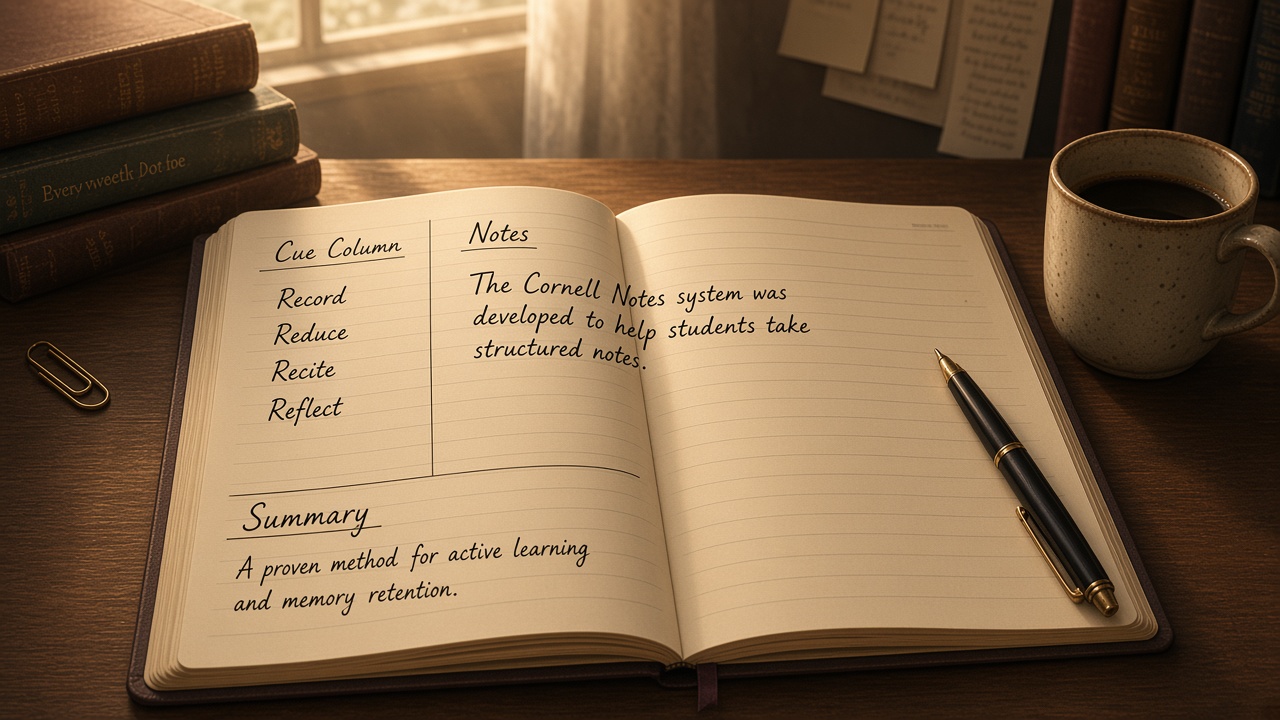
Why Cornell still matters in 2026
Walter Pauk did not invent a prettier page — he invented a memory pipeline. Students in his Cornell classes were not failing because they lacked effort. They were failing because their notes stopped at transcription. The Cornell layout adds two stages transcription alone cannot: condensation and self-testing.
That is the quiet difference between notes that decorate a folder and notes that survive a closed-book exam.
The three zones, explained
| Zone | Width | When you fill it | Purpose |
|---|---|---|---|
| Notes | ~70% (right) | During lecture | Capture ideas, examples, diagrams |
| Cues | ~30% (left) | Within 24 hours | Questions and keywords for retrieval |
| Summary | Full width (bottom) | Same day or next | Explain the page in plain language |
The cue column is not decoration. It is where you convert passive notes into active prompts — the difference between rereading and actually remembering.
Step-by-step: one lecture, one page
During class: Write in the main column only. Skip complete sentences. Leave space — you will need it for cues. If the professor repeats something twice, that is a cue waiting to happen.
Within 24 hours: Read the page once. Fill the left column with questions: "What triggers X?" "Define Y in one line." "What example proves Z?" Then write the bottom summary as if explaining the lecture to a friend who missed it.
Review: Fold or cover the notes column. Read each cue. Answer aloud. Uncover to check. Mark anything that failed — that is tomorrow's first five minutes.
Try RevuSchedule cue review before you forget the page
Cornell notes only work if you return to them. Revu schedules revision sessions on expanding intervals so your cue column becomes a living study plan.
View on App Store →A printable template (mental or literal)
You do not need a branded notebook. Draw a line two inches from the left edge. Draw a horizontal line four lines from the bottom. Header each page with date, course, and topic. That is the entire apparatus.
For digital users: split a document into two columns, or use a template in GoodNotes, Notability, or any markdown editor with a table layout. The medium is irrelevant; the review ritual is not.
Common mistakes (and honest fixes)
- Filling cues during lecture. You will miss what is being said. Cues are a post-lecture job.
- Writing cues that copy the notes. "Mitochondria = powerhouse" is not a cue. "What organelle produces ATP?" is.
- Skipping the summary. If you cannot summarize, you did not understand — and the exam will notice.
- Never reviewing. Cornell without scheduled review is just expensive lined paper.
Notes are raw material. Cues are the study session. The summary is the proof you were paying attention.
When Cornell is the wrong tool
Fast-moving seminars with heavy discussion, lab sessions built around diagrams, or courses where the textbook is the primary source may need hybrid approaches. Cornell shines in lecture-heavy courses where information arrives linearly and exams reward factual recall plus explanation.
If your notes already work — you review them, you pass, you remember — do not fix what is not broken. Cornell is for the gap between "I wrote it down" and "I can retrieve it under pressure."