The claim
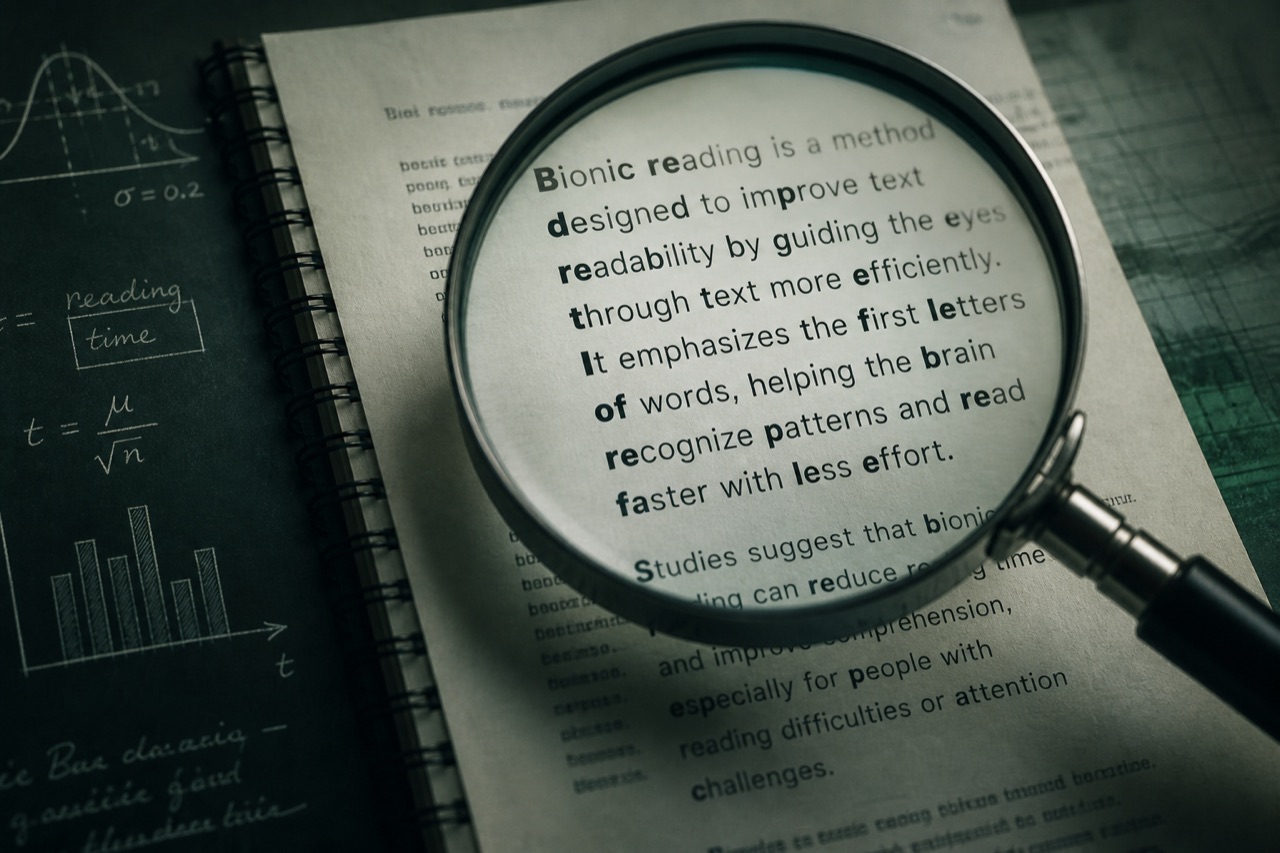
Bionic reading promises that partial bolding lets your brain “fill in” the rest of each word, unlocking higher speed with equal understanding. The marketing is elegant. The burden of proof is not.
Related on GeekFlux: continue with speed reading apps, ADHD reading focus, and comprehension strategies.
What the evidence trend says
Across recent experimental work and critical reviews, the consistent pattern is underwhelming for general readers: bold cues rarely produce meaningful, durable gains once you control for practice effects and motivation. Some papers report null results; others find tiny effects that vanish outside the lab.
That does not make every user a liar. Subjective ease is real. Ease is not the same as measured comprehension at higher WPM.
| Approach | Evidence strength (general readers) | Best use |
|---|---|---|
| Bionic bolding | Weak / mixed | Optional comfort styling |
| RSVP / guided pacing | Moderate for throughput | Dense PDFs, short focus sprints |
| Distraction control | Strong practical | Any long-form reading |
| Retrieval after reading | Strong for memory | Study and nonfiction |
Focus tools beyond typography
ReadFast pairs optional bionic styling with RSVP, focus mode, and PDF reading — so you can test what actually helps you finish.
View on App Store →Where bionic styling may still help
Readers who struggle with visual tracking or certain learning differences sometimes report that anchored bolding reduces decoding friction. That is a different claim than “everyone reads 3× faster.” Product honesty means separating accessibility comfort from universal speed myths.
A better stack for 2026
- Fix the environment first.
- Use pacing when regression loops start.
- Verify understanding with a one-sentence summary.
- Schedule a spaced review if the material must stick (pair with a revision planner).
Typography can be kind. It is not magic.