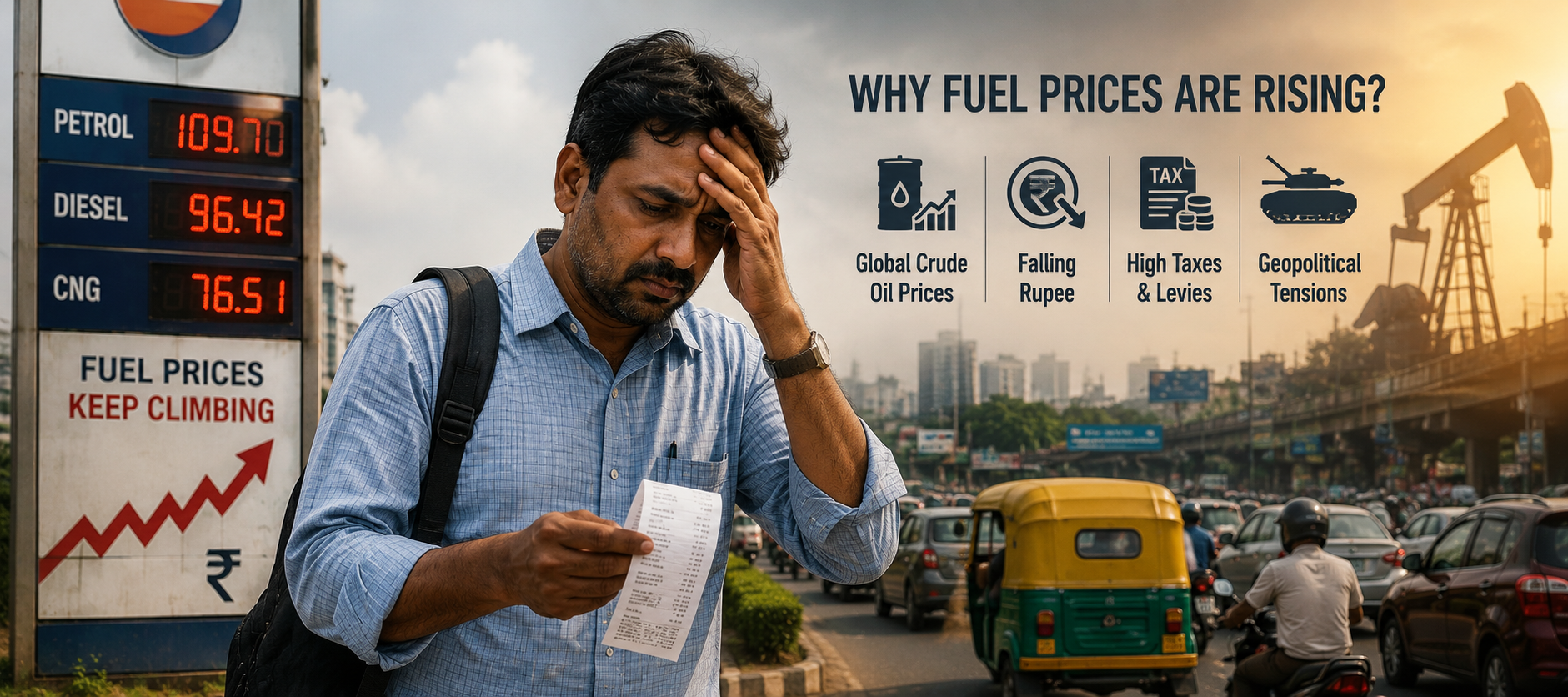
You start filling fuel, glance at the numbers climbing upward at warp speed, and suddenly wonder:
“Why is petrol becoming so expensive in India?”
The answer stretches far beyond your local fuel station. Petrol prices in India are deeply connected to global conflicts, crude oil imports, the US dollar, shipping routes, and government taxes.
In this detailed guide, we break down:
- Why petrol prices are rising in India
- How global conflicts impact fuel costs
- Why the Indian rupee matters
- The role of taxes in petrol pricing
- Why petrol costs differ between Delhi, Mumbai, Bengaluru, and Kolkata
- What could happen next
India’s heavy dependence on imported crude oil
India is one of the world’s largest consumers of crude oil, but it produces only a small portion domestically.
Today, India imports roughly 85% to 90% of its crude oil requirements, making the country highly vulnerable to global oil market shocks. Industry reporting on fuel retailers and national supply continues to underline that exposure—see ongoing Reuters energy coverage for market context.
For official import statistics, refer to the Petroleum Planning & Analysis Cell (PPAC) import data.
That means the petrol in your vehicle has often travelled thousands of kilometres before reaching your city.
Whenever global oil supply chains wobble, Indian consumers immediately feel the impact.
1. Global conflict and the crude oil shock
One of the biggest reasons behind rising fuel prices is geopolitical tension in West Asia.
A critical maritime route called the Strait of Hormuz handles a massive share of global oil transportation. According to multiple energy reports, nearly 20% of the world’s oil supply flows through this narrow sea route.
Recent conflicts involving Iran, the US, and regional powers have disrupted oil transportation and triggered fears of supply shortages. Reuters has reported on India racing to shield the economy from war-driven oil shock and capital stress.
As shipping becomes risky:
- Insurance costs rise
- Oil tanker movement slows
- Supply tightens
- Global crude prices surge
This has pushed Brent crude oil prices beyond roughly $100–$110 per barrel in stressed periods, increasing fuel import costs for countries like India.
For readers interested in global crude benchmarks, the U.S. Energy Information Administration (EIA) oil market analysis for India provides deeper insight into dependency and international crude trends.
2. Oil marketing companies could no longer absorb the losses
For a long time, petrol prices in India appeared relatively stable despite turbulence in global oil markets.
That happened because India’s major state-owned oil companies—Indian Oil Corporation, Bharat Petroleum, and Hindustan Petroleum—were absorbing a large portion of the cost increases instead of immediately passing them to consumers.
Think of them as giant economic shock absorbers.
But sustained high crude prices became financially unsustainable. Reporting on the national conversation around retailer losses—including how long fuel retailers can bear losses—illustrates the pressure.
Eventually:
- Cheaper oil inventory ran out,
- Financial pressure intensified, and
- Retail fuel prices had to rise.
The fuel price increase that consumers now see is essentially delayed global pain finally reaching the pump.
3. The falling rupee made fuel even more expensive
Here is the invisible multiplier behind rising petrol prices: the US dollar.
Crude oil is traded globally in dollars, not rupees.
So when the Indian rupee weakens against the US dollar:
- India must spend more rupees for the same barrel of oil
- Import costs rise sharply
- Fuel becomes more expensive domestically
Energy-market reporting has tied rupee stress to wider oil-shock conditions—see again Reuters on India’s response to oil shock and capital stress.
This creates a double burden:
- Crude oil itself becomes expensive
- The currency used to buy it also becomes costlier
That is like paying surge pricing on top of surge pricing. 📈
For currency and macroeconomic tracking, the Reserve Bank of India (RBI) financial markets section is a useful reference.
4. Taxes make up a huge part of petrol prices
Many people assume petrol prices are driven purely by crude oil costs.
But taxes form a surprisingly large share of the final amount consumers pay.
Once crude oil reaches India and gets refined into petrol, several taxes are added:
Central excise duty
A fixed tax imposed by the central government.
State VAT (value added tax)
A state-level percentage tax that varies across India.
Because VAT differs from state to state, petrol prices vary dramatically between cities.
That is why Delhi often posts lower headline fuel prices than Mumbai, Kolkata, or Bengaluru, where state VAT structures can bite harder.
For official tax and petroleum policy information, readers can explore the Ministry of Petroleum and Natural Gas.
Current petrol prices across major Indian metro cities
Here is an approximate snapshot of petrol prices across major Indian metro cities. Figures move with daily revisions; treat this table as a directional comparison rather than a live ticker.
| City | Petrol price (per litre) |
|---|---|
| Kolkata | ~₹109.70 |
| Mumbai | ~₹107.59 |
| Bengaluru | ~₹106.17 |
| Chennai | ~₹104.49 |
| Delhi | ~₹98.64 |
The difference largely comes from local taxation policies and state VAT structures.
Why rising petrol prices affect the entire economy
Fuel prices do not impact only car owners.
Expensive petrol and diesel quietly spread inflation across the economy like heat travelling through metal.
Higher fuel costs increase:
- Transportation expenses
- Grocery delivery charges
- Flight ticket prices
- Cab fares
- Manufacturing costs
- Food prices
That is why rising crude oil prices often trigger broader inflation concerns across India’s economy.
What could bring petrol prices down?
Fuel prices may stabilise if:
- Geopolitical tensions ease,
- Global oil supply improves,
- The rupee strengthens, or
- Governments reduce taxes.
However, prices could remain elevated if:
- Conflicts continue,
- Crude oil supply remains constrained, or
- Global demand rises further.
India has also been diversifying crude imports to reduce dependency on vulnerable routes like the Strait of Hormuz. Official messaging on supply security appears in releases such as the Press Information Bureau (PIB) note on energy supplies and import diversification.
Final thoughts
A litre of petrol in India carries far more than fuel.
It carries international geopolitics, shipping disruptions, currency fluctuations, taxation policy, and global economic uncertainty.
So the next time the fuel pump numbers climb faster than expected, remember: your petrol bill is partly written in oil fields, war rooms, shipping lanes, currency markets, and government budgets across the world. 🌍⛽