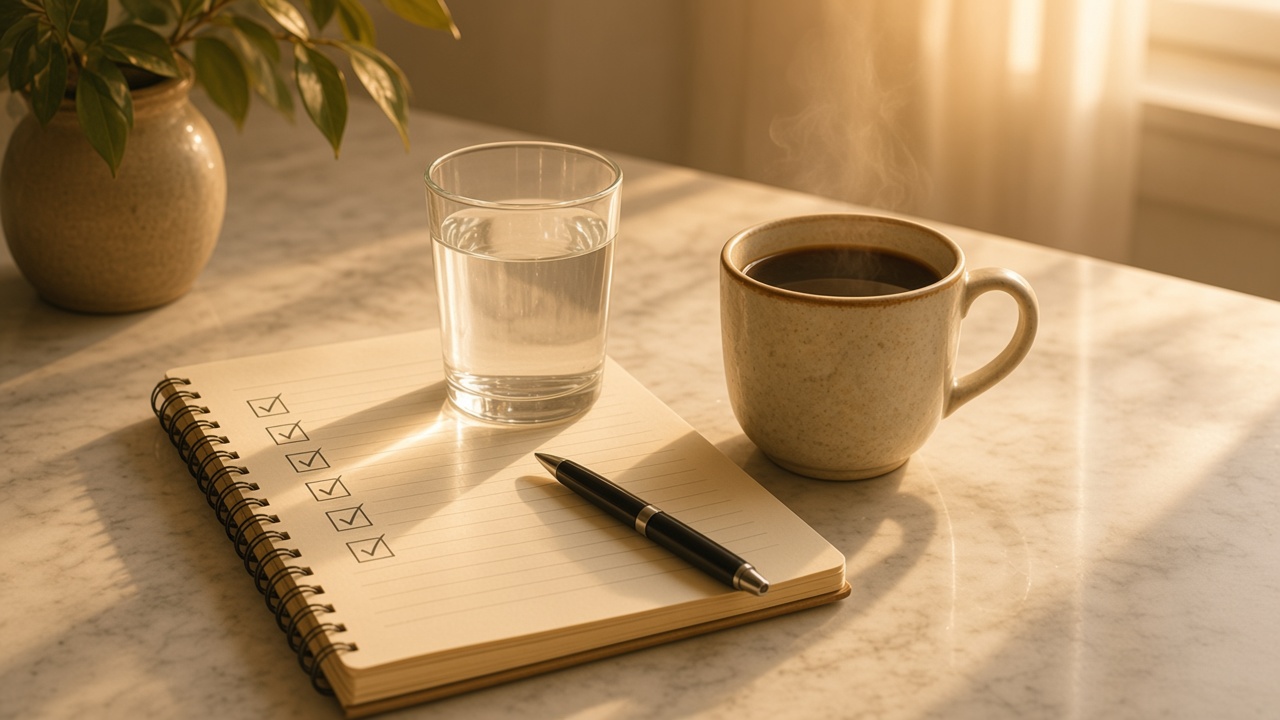
What “morning routine” means in research
Academic literature rarely studies “morning routines” as a branded product. It studies habit formation, circadian alignment, and self-regulation depletion — the idea that willpower is a finite morning resource if you spend it choosing socks, apps, and priorities from scratch.
A routine is successful when it converts repeated chaos into automatic sequence. The brain loves cues: alarm → bathroom → kettle → desk. Each link lowers the activation energy for the next.
Evidence-backed ingredients
| Element | What studies suggest | Practical version |
|---|---|---|
| Morning light | Helps entrain circadian rhythm | 5–10 min outside or by a bright window |
| Hydration | Reverses overnight fluid loss | One glass of water before coffee |
| Movement | Raises alertness, mood | Walk, stretch, or 7-minute workout |
| Planning | Reduces reactive drift | Write one priority before opening inbox |
| Consistent wake | Stabilizes sleep–wake cycle | Same alarm time ±30 minutes |
Notice what is missing: ice baths, elaborate journaling, forty-minute meditation unless you already do those willingly. The science favors adherence over aesthetics.
Why influencer routines fail for normal humans
Three failure modes show up constantly in reader mail:
- Duration inflation — a 90-minute routine cannot survive exam week or a sick kid.
- Chronotype mismatch — night owls forcing 5 a.m. stacks burn out by Wednesday.
- No anchor cue — habits float without attachment to coffee, commute, or opening the laptop.
Habit stacking — pairing a new behavior to an existing one — solves the anchor problem. We cover practical stacks in a companion piece; here the point is mechanism: routines are chains, not performances.
Decision fatigue: the hidden benefit
Every unplanned choice — which app, which task, which breakfast — spends attention you need for deep work or study. A minimal morning script preserves cognitive budget. That is why “make bed, water, one paragraph of reading” can outperform a chaotic hour of “optimizing.”
Students especially benefit: the morning you do not negotiate with yourself is the morning you actually open the textbook.
Try StreaklyTrack the stack, not the fantasy
Log your three morning cues in Streakly — one tap per step, streaks that survive imperfect weeks.
View on App Store →A science-respecting template (20 minutes)
- Wake + light (3 min) — curtains open or step outside.
- Water + movement (7 min) — glass of water, brief stretch or walk.
- Plan one thing (5 min) — single sentence: “Today counts if I ___.”
- Start the thing (5 min) — open the doc, book, or problem set; no inbox.
Repeat until automatic, then add one link — not five.
The best morning routine is the one you still do when life gets loud.