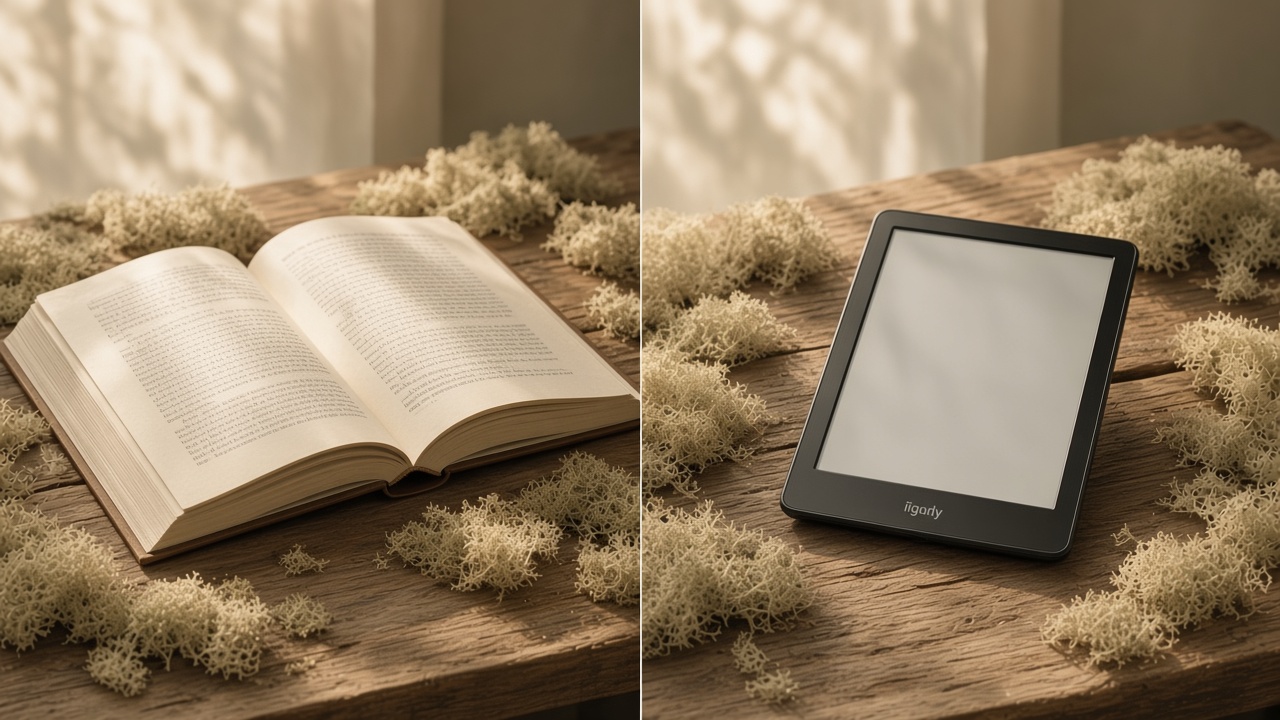
The question behind the debate
Every semester someone asks whether their Kindle is sabotaging their comprehension. The honest answer from reading research is messier than bookstore aesthetics: format interacts with purpose. A novel on e-ink is not the same cognitive event as a PDF on a glowing laptop with Slack in the dock.
Meta-analyses and lab studies over the past decade find small but real differences favoring paper for certain tasks — especially when readers need to remember where information appeared and follow long narrative arcs. Digital reading often correlates with faster pacing and more skimming. That pattern hurts retention whether the screen is e-ink or LCD.
What paper seems to do better
Physical books offer tactile landmarks: thickness in the left hand, a crease near the middle, a coffee stain on chapter nine. Those cues become part of memory — what psychologists sometimes call spatial situational model. When you recall a plot twist, you may literally remember it was on the right-hand page two-thirds through.
Studies by Mangen, Ackerman, and others have reported advantages for paper on some comprehension and sequencing tasks. The effect sizes are not cosmic. They are enough to matter for students who read once and hope the text sticks.
| Factor | Paper | E-reader / screen |
|---|---|---|
| Spatial memory cues | Strong (page thickness, layout) | Weaker (fluid pagination) |
| Distraction risk | Low if phone is elsewhere | Variable — e-ink low, phone high |
| Search & portability | Weak | Strong |
| Deep reading when focused | Excellent | Excellent with right habits |
What screens do better — when used deliberately
Kindles and similar e-ink devices remove much of the shallowing pressure of backlit multitasking devices. You get a library in a bag, adjustable type, built-in dictionaries, and highlights you can export — if you export them into a review system instead of a graveyard.
For academic and professional reading, search beats flipping. For travel, weight beats nostalgia. The device is rarely the bottleneck; the reading session design is.
The shallowing hypothesis — and how to reverse it
Researchers worry that screens train faster, less reflective reading — what some call the shallowing hypothesis. The fix is not Luddism. It is friction by design: timed blocks, single-tasking, note-taking that forces selection, and a closing ritual that converts exposure into memory.
After each chapter, close the book or lock the screen and write five sentences from memory. That one habit erases much of the format gap in real life, even if lab studies still show a paper edge on narrow tests.
Try ReadFastRead on screen without losing the thread
ReadFast adds focus mode and pacing to digital reading — so your Kindle session does not dissolve into notification drift.
View on App Store →A hybrid shelf that respects biology
- Fiction & long narrative: paper or e-ink, phone in another room, 25-minute blocks.
- Reference & textbooks: digital for search; paper for problem sets that need margin space.
- Commute reading: e-ink or audio with same-day summary notes.
- Exam-critical material: whichever format you will review — schedule retrieval at 1 and 7 days.
What to ignore in the format wars
Ignore absolutes. Ignore influencers who treat paper as virtue and screens as vice, or the reverse. Ignore highlight counts as progress. Track recall, not pages. The student who retrieves weekly on a Kindle outremembers the aesthete who collects unread hardcovers.
The book is a delivery mechanism. Memory is built in the rehearsal after delivery.