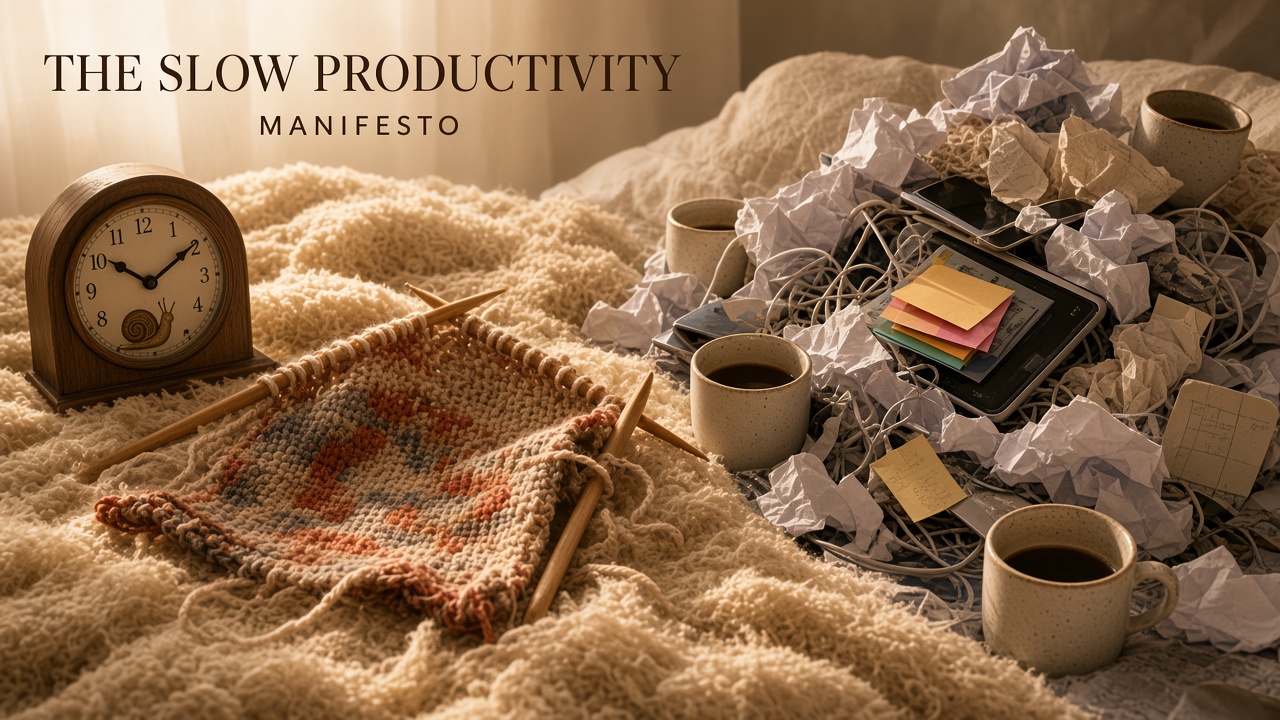
The productivity performance
For a decade, professional esteem tracked motion: inbox zero screenshots, 5 a.m. routines, side projects announced before started. The pandemic blurred home and office; the blur became a stage. Busyness became identity.
Cal Newport’s slow productivity is partly pushback against that theater — a reminder that knowledge work rewards cumulative depth, not cumulative posting.
Three principles
- Do fewer things — active projects have a hard cap.
- Work at a natural pace — seasons of intensity, seasons of recovery.
- Obsess over quality — finish artifacts that can be judged, not just started.
Students live a compressed version: five courses pretending to be five full-time jobs. Slow productivity here is triage — not heroic all-nighters, but honest bets on what the exam actually tests.
| Hustle metric | Slow alternative |
|---|---|
| Hours logged | Problems solved closed-book |
| Tasks checked | Artifacts shipped |
| Always available | Protected deep blocks |
Consistency without the hustle badge
Slow productivity still needs rhythm. Streakly tracks the small show-ups — daily reading, review, deep blocks — without gamifying burnout.
View on App Store → Try ReadFastDepth reading in stolen hours
When depth is the goal, ReadFast helps you finish long readings in focused sessions instead of ten abandoned tabs.
View on App Store →Permission structures
Slow productivity fails without boundaries — managers who reward responsiveness, courses that reward volume. You may need explicit scripts: “I am heads-down on X until Thursday.” “This week’s deliverable is Y; Z waits.”
Culture change starts personal, becomes political. The manifesto is not monk mode; it is refusing to confuse motion with progress when the work requires thinking.
Output is what you show. Depth is what you keep. Build a life that protects the second.